
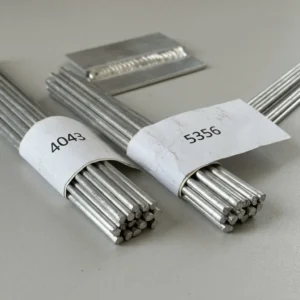
On this aluminum filler rod chart, 6061 takes 4043 for general work or 5356 for strength and anodizing, 5052 takes 5356, and 5083 and 5086 rule out 4043 because they hold more than 2.5% magnesium. Pick your two alloys and what the part must do below (strength, anodizing, heat, heat treatment) to get the filler, a second choice and what to avoid, with Lincoln’s chart and Hobart’s rule side by side.
Which aluminum filler: 4043 or 5356?
Pick the two alloys you are joining and what the part must do. You get the filler, a second choice, Lincoln’s and Hobart’s picks side by side, and what to avoid.
4043
6061/6063 both sides, general repair or fabrication
- Second choice5356Stronger fillets, and the color match if anodized.
- Lincoln’s chart4043 or 5356
- Hobart’s rule4043/4943 or 5356
- Avoid5356 above 150°FLong hot service can stress-crack it.
- Watch for24 ksi as weldedCode minimum for 6061-T6 welds, against 40 ksi unwelded. No filler restores it.
- Instead
- Code, pressure and structural work: the designer’s filler call-out wins.
Show the working
- Lincoln’s filler chart (Aluminum GMAW Welding Guide C8.100, Table 8) lists 4043 or 5356 for 6061/6063 to 6061/6063, as the best choice for most structural work. Its notes: where it shows 4043, 4047 also works; where it shows 5356, so do 5556 and 5183.
- Lincoln on 6xxx alloys such as 6061 and 6063: welded without filler they almost always crack, and no 6061 filler exists. Either 4043 or 5356 changes the weld’s chemistry enough to stop that; 4043 is the most common pick.
- Hobart’s guide: for 6xxx alloys, and 5xxx alloys up to 2.5% magnesium such as 5052, use either 4043/4943 or 5356. The two cover over 85% of aluminum welds.
- Where both fit, Lincoln’s comparison is: 4043 flows better and cracks less; 5356 is stronger, above all in fillet welds, and more ductile.
- Welded 6061-T6: all codes ask 40 ksi (276 MPa) of the unwelded metal and 24 ksi (165 MPa) of the weld (Lincoln). Hobart’s typical as-welded figure is 27 ksi, with 30–50% lost in the heat-affected zone.
- On the label: Lincoln lists its wires as ER4043, ER5356 and so on, the AWS A5.10 classes; Hobart sells its 4943 as ER4943 MIG wire and R4943 TIG rod.
- This summarizes the makers’ charts for general repair and fabrication. Your filler maker’s own chart wins, and code, pressure or structural work follows the designer’s filler call-out.
Aluminum filler rod chart by alloy
Each row is one joint. “Lincoln’s chart” is the filler in Lincoln Electric’s chart for structural welding, and “Hobart’s rule” is what Hobart’s selection rules say for the same two alloys. The other columns are this page’s pick for each job: always a filler one of the two makers names for that joint. “No good match” means neither maker lists a filler that suits.
| Joint | Lincoln’s chart | Hobart’s rule | General work | Strength first | To be anodized | Above 150°F | Heat treated after | Easiest puddle |
|---|---|---|---|---|---|---|---|---|
| The same alloy on both sides | ||||||||
| 6061/6063 | 4043 or 5356 | 4043/4943 or 5356 | 4043 | 5356 | 5356 | 4043 | 4943 | 4043 |
| 5052 | 5356 | 4043/4943 or 5356 | 5356 | 5356 | 5356 | 4043 | — | 4043 |
| 5083 | 5556 or 5183 | 5356, not 4043/4943 | 5556 or 5183 | 5556 or 5183 | 5556 or 5183 | No good match | — | 5556 or 5183 |
| 5086 | 5356 | 5356, not 4043/4943 | 5356 | 5356 | 5356 | No good match | — | 5356 |
| 5454 | 5554 | 5356, not 4043/4943 | 5554 | 5554 | 5554 | 5554 | — | 5554 |
| 3003 | 1100 | 4043 or 4943 | 4043 | 5356 | 5356 | 4043 | — | 4043 |
| 1100 | 1100 | 4043 or 4943 | 1100 | 4943 | 1100 | 1100 | — | 4043 |
| cast 356 | 4043 | 4043 or 4943 | 4043 | 4943 | 4043 (anodizes dark gray) | 4043 | 4943 | 4043 |
| 7005 | 5356 | — | 5356 | 5356 | 5356 | No good match | 5356 | 5356 |
| 6061 or 6063 to another alloy | ||||||||
| 6061/6063 to 5052 | 5356 or 4043 | 4043/4943 or 5356 | 5356 | 5356 | 5356 | 4043 | 4943 | 4043 |
| 6061/6063 to 5083 | 5356 | 5356, not 4043/4943 | 5356 | 5356 | 5356 | No good match | 5356 | 5356 |
| 6061/6063 to 5086 | 5356 | 5356, not 4043/4943 | 5356 | 5356 | 5356 | No good match | 5356 | 5356 |
| 6061/6063 to 5454 | 5356 | 5356, not 4043/4943 | 5356 | 5356 | 5356 | 5554 | 5356 | 5356 |
| 6061/6063 to 3003 | 4043 | 4043 or 4943 | 4043 | 4943 | 4043 (anodizes dark gray) | 4043 | 4943 | 4043 |
| 6061/6063 to 1100 | 4043 | 4043 or 4943 | 4043 | 4943 | 4043 (anodizes dark gray) | 4043 | 4943 | 4043 |
| 6061/6063 to cast 356 | 4043 | 4043 or 4943 | 4043 | 4943 | 4043 (anodizes dark gray) | 4043 | 4943 | 4043 |
| 6061/6063 to 7005 | 5356 | — | 5356 | 5356 | 5356 | No good match | 5356 | 5356 |
| 5052 to another alloy | ||||||||
| 5052 to 5083 | 5356 | 5356, not 4043/4943 | 5356 | 5356 | 5356 | No good match | — | 5356 |
| 5052 to 5086 | 5356 | 5356, not 4043/4943 | 5356 | 5356 | 5356 | No good match | — | 5356 |
| 5052 to 5454 | 5356 | 5356, not 4043/4943 | 5356 | 5356 | 5356 | 5554 | — | 5356 |
| 5052 to 3003 | 4043 | 4043 or 4943 | 4043 | 4943 | 4043 (anodizes dark gray) | 4043 | — | 4043 |
| 5052 to 1100 | 4043 | 4043 or 4943 | 4043 | 4943 | 4043 (anodizes dark gray) | 4043 | — | 4043 |
| 5052 to cast 356 | 4043 | 4043 or 4943 | 4043 | 4943 | 4043 (anodizes dark gray) | 4043 | 4943 | 4043 |
| 5052 to 7005 | 5356 | — | 5356 | 5356 | 5356 | No good match | 5356 | 5356 |
| Other pairs | ||||||||
| 5083 to 5086 | 5356 | 5356, not 4043/4943 | 5356 | 5356 | 5356 | No good match | — | 5356 |
| 5083 to 5454 | 5356 | 5356, not 4043/4943 | 5356 | 5356 | 5356 | No good match | — | 5356 |
| 5083 to 3003 | 5356 | 5356, not 4043/4943 | 5356 | 5356 | 5356 | No good match | — | 5356 |
| 5083 to 1100 | 5356 | 5356, not 4043/4943 | 5356 | 5356 | 5356 | No good match | — | 5356 |
| 5083 to cast 356 | 5356 | 5356, not 4043/4943 | 5356 | 5356 | 5356 | No good match | 5356 | 5356 |
| 5083 to 7005 | 5556 | 5356, not 4043/4943 | 5556 | 5556 | 5556 | No good match | 5556 | 5556 |
| 5086 to 5454 | 5356 | 5356, not 4043/4943 | 5356 | 5356 | 5356 | No good match | — | 5356 |
| 5086 to 3003 | 5356 | 5356, not 4043/4943 | 5356 | 5356 | 5356 | No good match | — | 5356 |
| 5086 to 1100 | 5356 | 5356, not 4043/4943 | 5356 | 5356 | 5356 | No good match | — | 5356 |
| 5086 to cast 356 | 5356 | 5356, not 4043/4943 | 5356 | 5356 | 5356 | No good match | 5356 | 5356 |
| 5086 to 7005 | 5356 | 5356, not 4043/4943 | 5356 | 5356 | 5356 | No good match | 5356 | 5356 |
| 5454 to 3003 | 4043 | 5356, not 4043/4943 | 4043 | 4043 | 4043 (anodizes dark gray) | 4043 | — | 4043 |
| 5454 to 1100 | 4043 | 5356, not 4043/4943 | 4043 | 4043 | 4043 (anodizes dark gray) | 4043 | — | 4043 |
| 5454 to cast 356 | 4043 | 5356, not 4043/4943 | 4043 | 4043 | 4043 (anodizes dark gray) | 4043 | 4043 | 4043 |
| 5454 to 7005 | 5356 | 5356, not 4043/4943 | 5356 | 5356 | 5356 | No good match | 5356 | 5356 |
| 3003 to 1100 | 1100 | 4043 or 4943 | 1100 | 4943 | 1100 | 1100 | — | 4043 |
| 3003 to cast 356 | 4043 | 4043 or 4943 | 4043 | 4943 | 4043 (anodizes dark gray) | 4043 | 4943 | 4043 |
| 3003 to 7005 | 5356 | — | 5356 | 5356 | 5356 | No good match | 5356 | 5356 |
| 1100 to cast 356 | 4043 | 4043 or 4943 | 4043 | 4943 | 4043 (anodizes dark gray) | 4043 | 4943 | 4043 |
| 1100 to 7005 | 5356 | — | 5356 | 5356 | 5356 | No good match | 5356 | 5356 |
| cast 356 to 7005 | 4043 | — | 4043 | 4043 | 4043 (anodizes dark gray) | 4043 | 4043 | 4043 |
- A dash under “Heat treated after” means neither alloy hardens by heat treatment, so there is nothing to pick for. A dash under “Hobart’s rule” means the text of Hobart’s guide gives no rule for that alloy.
- Lincoln’s notes to its chart: where it shows 4043, 4047 also works; where it shows 5356, so do 5556 and 5183.
- 4943 is Hobart’s own alloy, so it never appears in Lincoln’s chart. Hobart lists it for the jobs 4043 does on 1xxx, 3xxx and 6xxx alloys, 5052 and 356 castings.
- The makers disagree on 5454. Hobart’s guide rules out 4043 and 4943 on any 5xxx alloy above 2.5% magnesium, and its tables put 5454 at 2.7–2.8%; a Hobart article draws that line at 3% instead; Lincoln’s chart uses 4043 to join 5454 to 1100, 3003 or 356 castings. Both columns are shown as each maker gives them.
- 2024 and 7075 are left out: Hobart lists them as non-weldable by arc welding, and Lincoln says most 2xxx and 7xxx alloys should not be arc welded.
This chart is for general repair and fabrication. Structural, pressure and marine parts follow a welding code or the designer’s filler call-out, and Lincoln notes that some jobs need a filler other than the one its chart shows. Where this chart and your filler maker’s own chart differ, the maker’s chart wins.
4043 vs 5356 vs 4943: the fillers compared
These are Hobart’s typical figures for its own filler metals, from the property tables in its Guide for Aluminum Welding. The tensile strength is for weld metal alone; the shear figures are Hobart’s minimums for fillet welds, loaded along the weld and across it.
| Filler | Tensile strength | Fillet shear, along | Fillet shear, across | Stretch before breaking | Resists cracking as it freezes | Color after anodizing | Magnesium |
|---|---|---|---|---|---|---|---|
| 4043 | 28 ksi (193 MPa) | 11.5 ksi (79 MPa) | 15 ksi (103 MPa) | 15% | Very good | Gray | None (5.0% silicon) |
| 4943 | 35 ksi (241 MPa) | 15.5 ksi (107 MPa) | 23 ksi (159 MPa) | 15% | Very good | Gray | 0.4% (5.2% silicon) |
| 5356 | 38 ksi (262 MPa) | 18 ksi (124 MPa) | 26 ksi (179 MPa) | 35% | Good | White | 5.0% |
| 5554 | 33 ksi (228 MPa) | 17 ksi (117 MPa) | 23 ksi (159 MPa) | 40% | Fair | White | 2.7% |
| 5183 | 41 ksi (283 MPa) | 18.5 ksi (128 MPa) | 28 ksi (193 MPa) | 25% | Good | White | 4.75% |
| 5556 | 42 ksi (290 MPa) | 20 ksi (138 MPa) | 30 ksi (207 MPa) | 25% | Good | White | 5.1% |
| 1100 | 13 ksi (90 MPa) | 7.5 ksi (52 MPa) | 7.5 ksi (52 MPa) | 55% | Good | — | None |
- Puddle and bead: Lincoln’s side-by-side gives 4043 a smooth bead, good wetting and less porosity, and 5356 black smut and distinct ripples. Miller calls 4043 the more forgiving of the two.
- Strength: Lincoln rates 5356 higher in tensile strength and ductility, and 4043 “much lower” in shear. Hobart’s rule of thumb is three fillet passes of 4043 to match one pass of 5356.
- Color: Hobart’s table lists 6061, 6063 and 3003 as clear after anodizing and 5052, 5083 and 5086 as white, the same as 5356. Its 4xxx fillers come out gray.
- MIG feeding: Hobart says 5356 is twice as stiff as 4043 and feeds better. Lincoln: 3/64 in (1.2 mm) 5356 can generally be pushed through the gun, 3/64 in 4043 usually gives feeding problems when pushed, and at 1/16 in (1.6 mm) either can be pushed.
- 4943 is 4043 with a little magnesium added (0.4% on Hobart’s table). Hobart says it runs on the same welding procedures as 4043, gives about 25% more tensile and shear strength and 50% more yield strength, and does not rely on base metal mixing into the weld for that strength.
What welding does to the metal’s strength
The filler is only half of a weld’s strength. Heat softens the metal beside the weld: Hobart puts the loss at 30–50% for 6xxx alloys, and Lincoln says welding codes ask 40 ksi (276 MPa) of 6061-T6 but only 24 ksi (165 MPa) of a weld in it. In a butt weld that soft zone usually breaks first, whatever the filler. In a fillet weld the filler’s shear strength carries the load, which is where 5356 or 4943 earns its place.
| Alloy and temper | Unwelded | After welding, typical | After welding, least expected |
|---|---|---|---|
| 6061-T6 | 45 ksi (310 MPa) | 27 ksi (186 MPa) | 24 ksi (165 MPa) |
| 6061-T6, solution heat treated and aged after welding | 45 ksi (310 MPa) | 44 ksi (303 MPa) | 38 ksi (262 MPa) |
| 5052-H32 | 35 ksi (241 MPa) | 28 ksi (193 MPa) | 25 ksi (172 MPa) |
| 5454-H34 | 44 ksi (303 MPa) | 35 ksi (241 MPa) | 31 ksi (214 MPa) |
| 5086-H34 | 47 ksi (324 MPa) | 39 ksi (269 MPa) | 35 ksi (241 MPa) |
| 5083-H116 / H321 | 46 ksi (317 MPa) | 43 ksi (296 MPa) | 40 ksi (276 MPa) |
- Hobart’s 6061 figures assume 4043 filler with at least 20% of the weld made up of melted base metal; its 5xxx figures are for 5xxx fillers and do not depend on that mixing.
- The 5xxx alloys lose less: welding only undoes their cold work, while 6061 loses the strength its heat treatment gave it (Hobart, Lincoln).
- The second 6061 row is a full solution heat treatment and aging after welding. Hobart calls the filler choice critical for that, and says to get the filler maker’s advice first.
Before you weld aluminum
- Always add filler on 6061, 6063 and 5052. Lincoln says 6xxx alloys welded without filler almost always crack; Hobart warns about fusing thin outside corners with TIG and no rod.
- Keep the heat down on 6061. Lincoln recommends no more than 200°F (93°C) of preheat and 250°F (121°C) between passes, and no wide weaving. Hobart’s limit is 250°F (121°C) for no more than 15 minutes, for heat-treatable alloys and for 5xxx alloys over 3% magnesium.
- Fill the crater. Hobart: speed up at the end of the weld, double back a short way, or use the machine’s crater-fill setting, so the end of the bead does not crack.
- Clean first. Hobart: wipe with a clean towel and a cleaner such as acetone, then take the oxide off with a stainless steel brush kept for aluminum.
- Keep rod and wire dry and covered, and bring them into the shop a day before welding so they do not sweat (Hobart).
- Shielding gas is 100% argon for both 4043 and 5356 (Hobart).
For aluminum amps, tungsten, cup size, argon flow and filler rod size by thickness, use the TIG welding settings chart. The MIG welding settings chart covers steel wire only: for aluminum MIG, start from the chart on your machine. The welding gas cylinder calculator shows how long an argon cylinder lasts.
Quick answers
What filler rod do I use for 6061 aluminum?
4043 for general work: Lincoln calls it the most common filler for 6xxx alloys, and it flows easier and cracks less. Use 5356 where strength comes first or the part will be anodized. Either way, a weld in 6061-T6 only has to make 24 ksi (165 MPa), against 40 ksi (276 MPa) for the unwelded metal, so no filler brings back full strength.
4043 vs 5356: which aluminum filler should I use?
In Lincoln’s comparison, 4043 flows better, cracks less and leaves a smooth bead; 5356 is stronger, more ductile and matches color when anodized. Hobart’s typical weld metal tensile strength is 28 ksi (193 MPa) for 4043 and 38 ksi (262 MPa) for 5356. Two hard limits: no 4043 on high-magnesium plate such as 5083 or 5086, and no 5356 for long service above 150°F (66°C).
What filler rod for 5052 aluminum?
5356 is Lincoln’s chart pick for 5052 to 5052: the alloy is crack-sensitive, and the extra magnesium in the filler helps. 4043 also works, since Lincoln and Hobart both allow it on 5052, and it is the pick for a part that runs hot. Never fuse 5052 without filler.
Can I weld 6061 to 5052, and with what filler?
Yes. Lincoln’s chart lists 5356 first for 6061 to 5052, and its text says to use 5356 to weld 6xxx alloys to any 5xxx alloy; 4043 is its second choice. Hobart’s rule allows either filler here, because 5052 is 2.5% magnesium.
4043 or 5356 for cast aluminum?
4043 for 356 and A356 castings, to themselves and to 6061: Lincoln says to use 4043 to weld 6xxx alloys to the common 3xx.x casting alloys. The exception is a casting joined to 5083 or 5086 plate, where its chart lists 5356. This covers 356-type castings only: an unmarked casting may be a different alloy. The metal identification chart helps sort out what a part is made of.
Which aluminum filler rod for anodizing?
5356 on 6061 and 6063. Lincoln says 5356 anodizes to a color very close to the parent metal, while 4043 turns dark gray and shows clearly. Hobart agrees, and puts it down to the free silicon in 4xxx fillers. Some forum posts say the opposite; both makers say 5356.
Can I use 4043 on 5083 or 5086 boat plate?
No. Lincoln says a 4xxx filler on high-magnesium 5xxx plate forms brittle magnesium silicide in the weld, and Hobart rules out 4043 and 4943 above 2.5% magnesium. For 5086 to 5086 Lincoln’s chart lists 5356. For 5083 to 5083 it lists 5556 or 5183, because 5356 often misses the 40 ksi (276 MPa) most structural codes ask.
Is 4943 better than 4043?
It is stronger on Hobart’s figures: 35 ksi (241 MPa) typical weld metal tensile strength against 28 ksi (193 MPa), with the same puddle and the same welding procedures. 4943 is Hobart’s own alloy, so Lincoln’s chart does not list it. Like 4043, it is not for 5xxx plate above 2.5% magnesium, and it still anodizes gray.
What filler for aluminum that runs hot, above 150°F?
4043 for 6061, 5052 and 3003: it has no magnesium to cause trouble. Hobart’s rule for long service above 150°F (66°C) is 5554 or 4043/4943, never 5356, and Lincoln gives the same limit for anything over 3% magnesium. That rules out 5083 and 5086 plate as well. The alloy made for hot service is 5454, welded with 5554.
Can you weld 7075 or 2024 aluminum?
Not with TIG or MIG. Hobart lists 2024 and 7075 as non-weldable by arc welding: they tend to crack as the weld solidifies and can stress-corrosion crack later, so they are typically bolted or riveted. 7005 is different: Lincoln’s chart lists 5356 for it.
- Filler by pair of alloys: Lincoln Electric, “Aluminum GMAW Welding Guide” (publication C8.100), its table of filler metals for structural welding and its section on filler metal selection. The fillers are classed under AWS A5.10.
- Selection rules, filler properties, welded strength, hot service, anodizing and alloys that cannot be arc welded: Hobart Brothers, “Guide for Aluminum Welding”, and the notes on Hobart’s Aluminum Filler Metal Selection Chart. That chart’s letter ratings are not used here.
- 4943, cracking, cleaning and storage: Hobart Brothers’ articles on 4943, on aluminum filler rod, on aluminum TIG filler metals, and its guide page on avoiding cracking.
- Ease of welding: Miller Electric, “Aluminum Welding Made Easier with the Right System, Filler Metal”.
- Where the two makers differ, both are shown and named. The picks in the “General work” to “Easiest puddle” columns are this page’s reading of those sources, not a maker’s chart.
Numbers compiled from the sources below and last updated on . Spotted a mistake? Tell us.
- Lincoln Electric, “Aluminum GMAW Welding Guide”, publication C8.100, issue 08/11 (Table 8, filler metals for structural welding of aluminum alloys; Table 7, 4043 against 5356; filler metal selection; welded strength; read as a distributor’s copy)
- Hobart Brothers, “Guide for Aluminum Welding”, 2019 (selection rules for 4043/4943 and 5356, 4943, elevated temperature, anodized color, non-weldable alloys, filler metal properties, welded properties of 5xxx and 6xxx alloys, preheat, post-weld heat treatment)
- Hobart Brothers, guide page “Guidelines for Selecting the Most Appropriate Filler Metal (4043/4943 or 5356)”
- Hobart Brothers, “Aluminum Filler Metal Selection Chart”, 2013 (what its ratings mean, notes on 4943 and 4047, the 5454 example; its letter ratings are not used)
- Hobart Brothers, guide page “How to Avoid Cracking in Aluminum Alloys” (5052, 6xxx alloys, craters)
- Hobart Brothers, “4943 Aluminum Filler Metals Exceed 4043 Weld Strength” (updated 2024)
- Hobart Brothers, “Choose Your Filler Metals: What About Aluminum Filler Rod?” (updated 2026; the 3% magnesium line, shielding gas)
- Hobart Brothers, “5 Tips for Understanding Aluminum TIG Filler Metals, Setup and Welding” (updated 2025; cleaning, storage)
- Miller Electric, “Aluminum Welding Made Easier with the Right System, Filler Metal” (2022)