
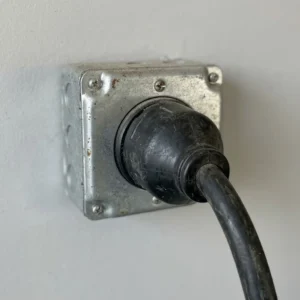
A 240 V welder that draws 30 A takes a 30 A breaker with 10 AWG copper wire on a shared circuit. On a circuit for the welder alone, NEC Article 630 allows 12 AWG household cable (NM-B) at a 30% duty cycle, with a breaker of up to 40 A. Enter the input amps and duty cycle from your nameplate in the welder breaker size chart below to see both rules worked out, the outlet (NEMA 6-50, 6-30 or 5-20), what six maker manuals list and the extension cord size. An electrician and your local inspector have the final say.
Size your welder circuit
Enter the input volts, rated input amps and duty cycle from the nameplate on your welder. You get the copper wire and breaker two ways: for a circuit that serves the welder alone, and for a circuit shared with anything else.
Circuit for the welder alone
12 AWG
Breaker up to 40 A
Circuit shared with other loads
10 AWG
30 A breaker
Copper wire and breaker for a 240 V welder that draws 30 A at full output
- Welder-only circuit12 AWG · breaker up to 40 AFor a circuit that feeds only the welder.
- Shared circuit10 AWG · 30 A breakerWhen anything else shares the circuit.
- Your manual
- OutletNEMA 6-50 or 6-30Match the plug on your welder’s cord.
- Dryer or range outletCovers 30 A on paperDryer (30 A) or range (50 A), only if all four are true:
- The plug fits (a 6-50 welder plug does not)
- The outlet is grounded (four slots)
- Nothing else runs on it while you weld
- The breaker follows the shared-circuit rule
- Extension cord10 AWG cordFor 25 ft. Good to 75 ft at 30 A.
- Your welder’s manual wins. An electrician and your local inspector have the final say.
Show the working
- Welder rule, wire (NEC 630.11): 30 A × 0.55, the factor for a 30% duty cycle, = 16.5 A. That takes 12 AWG copper, good for 20 A.
- Welder rule, breaker (NEC 630.12): no more than 200% of the 30 A input (60 A) and 200% of the wire’s 20 A (40 A). So 40 A at most.
- Why the wire can be smaller: a welder rests between welds, so the code sizes its wire for the effective current. Only on a circuit that feeds the welder alone.
- General rule (NEC 240.4): the first standard breaker at or above 30 A is 30 A. Wire rated for that breaker is 10 AWG copper, good for 30 A.
- Outlet: NEMA 6-50 (250 V, 50 A) on the Miller and Hobart machines we read, 6-30 (250 V, 30 A) on Lincoln’s Invertec V155-S.
- On a welder-only circuit the code lets the outlet or the wire be rated below the breaker, as long as every part physically fits; Miller’s manuals point to NEC 210.21, 630.11 and 630.12.
- Extension cord: Miller’s table keeps the voltage drop to 2% or less. In its 30 A row for 240 V, 10 AWG reaches 75 ft. If your manual names a cord, use the manual’s.
Welder breaker and wire size chart
Two rules in the US National Electrical Code (NEC) can size a welder circuit, and most forum arguments come from mixing them up. The chart shows both for common input amps, in copper household cable (NM-B, Romex) at its 60°C ratings.
The general rule (NEC 240.4): take the first standard breaker at or above the welder’s input amps, then wire rated for that breaker. Small wire has fixed limits: 14 AWG on 15 A, 12 AWG on 20 A and 10 AWG on 30 A. Any circuit that can feed something else follows this rule.
The welder rule (NEC 630.11 and 630.12): a welder rests between welds, so its wire may be sized for the effective current. That is the I1eff on the nameplate or, without one, the rated input amps times a duty cycle factor. The breaker may then be up to 200% of the input amps and up to 200% of the wire’s rating, whichever is lower. The small-wire limits step aside for equipment that has its own article (240.4(G)), and arc welders have one: Article 630.
The welder rule is only for a circuit that serves the welder alone. Plug anything else into that outlet and the wire is too small for its breaker under the general rule.
| Welder input amps | Shared circuit: breaker | Shared circuit: wire | Welder only, 20% duty cycle or less | Welder only, 30% duty cycle | Welder only, 40% duty cycle | Welder only, 60% duty cycle | Welder only, 100% duty cycle |
|---|---|---|---|---|---|---|---|
| 15 A | 15 A | 14 AWG | 14 AWG, up to 30 A | 14 AWG, up to 30 A | 14 AWG, up to 30 A | 14 AWG, up to 30 A | 14 AWG, up to 30 A |
| 20 A | 20 A | 12 AWG | 14 AWG, up to 30 A | 14 AWG, up to 30 A | 14 AWG, up to 30 A | 12 AWG, up to 40 A | 12 AWG, up to 40 A |
| 25 A | 25 A | 10 AWG | 14 AWG, up to 30 A | 14 AWG, up to 30 A | 12 AWG, up to 40 A | 12 AWG, up to 40 A | 10 AWG, up to 50 A |
| 30 A | 30 A | 10 AWG | 14 AWG, up to 30 A | 12 AWG, up to 40 A | 12 AWG, up to 40 A | 10 AWG, up to 60 A | 10 AWG, up to 60 A |
| 35 A | 35 A | 8 AWG | 12 AWG, up to 40 A | 12 AWG, up to 40 A | 10 AWG, up to 60 A | 10 AWG, up to 60 A | 8 AWG, up to 70 A |
| 40 A | 40 A | 8 AWG | 12 AWG, up to 40 A | 10 AWG, up to 60 A | 10 AWG, up to 60 A | 8 AWG, up to 80 A | 8 AWG, up to 80 A |
| 45 A | 45 A | 6 AWG | 10 AWG, up to 60 A | 10 AWG, up to 60 A | 10 AWG, up to 60 A | 8 AWG, up to 80 A | 6 AWG, up to 90 A |
| 50 A | 50 A | 6 AWG | 10 AWG, up to 60 A | 10 AWG, up to 60 A | 8 AWG, up to 80 A | 8 AWG, up to 80 A | 6 AWG, up to 100 A |
| 60 A | 60 A | 4 AWG | 10 AWG, up to 60 A | 8 AWG, up to 80 A | 8 AWG, up to 80 A | 6 AWG, up to 110 A | 4 AWG, up to 110 A |
| 70 A | 70 A | 4 AWG | 8 AWG, up to 80 A | 8 AWG, up to 80 A | 6 AWG, up to 110 A | 6 AWG, up to 110 A | 4 AWG, up to 125 A |
| 80 A | 80 A | 3 AWG | 8 AWG, up to 80 A | 6 AWG, up to 110 A | 6 AWG, up to 110 A | 4 AWG, up to 125 A | 3 AWG, up to 150 A |
These are code minimums, not a wiring plan. The manual for your machine may ask for heavier wire or a smaller breaker, and it wins. The chart is for household NM-B cable, which is held to the 60°C ratings. Individual wires in conduit (THHN or THWN) on terminals marked 75°C can sometimes be a size smaller: pick that in the calculator. Aluminum wire, long runs and old or recalled panels are outside this chart: ask an electrician.
Once the outlet is in, the MIG welding settings chart and the stick welding amperage chart give starting settings. No outlet where you weld? See the generator size calculator for welders.
Duty cycle factors for welder wire
When the nameplate has no I1eff, the code multiplies the rated input amps by a factor for the duty cycle at rated output. These are the factors for transformer and inverter welders; motor-generator sets have their own. A duty cycle between two rows is worked on the higher row.
| Duty cycle on the nameplate | Factor | A 50 A input counts as |
|---|---|---|
| 20% or less | 0.45 | 22.5 A |
| 30% | 0.55 | 27.5 A |
| 40% | 0.63 | 31.5 A |
| 50% | 0.71 | 35.5 A |
| 60% | 0.78 | 39 A |
| 70% | 0.84 | 42 A |
| 80% | 0.89 | 44.5 A |
| 90% | 0.95 | 47.5 A |
| 100% | 1.00 | 50 A |
Copper wire ratings used
Amps a copper wire may carry, from the code’s wire table (Table 310.16). Equipment rated 100 A or less uses the 60°C figures unless its terminals are marked 75°C, and NM-B cable is always held to 60°C.
| Copper wire | At 60°C (NM-B cable) | At 75°C (wire in conduit) | Breaker limit on a shared circuit |
|---|---|---|---|
| 14 AWG | 15 A | 20 A | 15 A |
| 12 AWG | 20 A | 25 A | 20 A |
| 10 AWG | 30 A | 35 A | 30 A |
| 8 AWG | 40 A | 50 A | — |
| 6 AWG | 55 A | 65 A | — |
| 4 AWG | 70 A | 85 A | — |
| 3 AWG | 85 A | 100 A | — |
| 2 AWG | 95 A | 115 A | — |
| 1 AWG | — | 130 A | — |
| 1/0 AWG | — | 150 A | — |
Breaker and wire sizes in welder manuals
What six owner’s manuals list for a circuit that serves the welder alone, on 230 or 240 V. The makers work from the same welder rule, then often choose a smaller fuse or heavier wire than the code minimum. Their wire sizes are for wires in conduit: Miller’s Multimatic 235 and Lincoln’s Power MIG 200 manuals say 75°C copper. In household NM-B cable the code minimum can be a size larger, and the calculator shows it. Where the manual and the code differ, use the stricter figure.
| Welder | Input at rated output | Rated output | Fuse or breaker | Smallest wire | Longest run for that wire | Plug |
|---|---|---|---|---|---|---|
| Miller Millermatic 211 | 16.6 A at 240 V | 150 A at 21.5 V, 40% duty cycle | 25 A time-delay or 30 A normal | 14 AWG | 72 ft (22 m) | NEMA 6-50P |
| Miller Multimatic 235 | I1max 31.2 A, I1eff 18.6 A at 240 V | 235 A at 25.8 V, 20% duty cycle | 35 A time-delay or 45 A normal | 12 AWG | 58 ft (18 m) | NEMA 6-50P |
| Hobart Handler 210 MVP | 24 A at 230 V | 150 A at 23 V, 30% duty cycle | 30 A time-delay or 35 A normal | 14 AWG | 53 ft (16 m) | NEMA 6-50P |
| Lincoln Invertec V155-S | 33 A at 230 V | 145 A stick at 25.8 V, 30% duty cycle | 30 A time-delay at most | 12 AWG input cord; no wall wire size given | — | NEMA 6-30P |
| Lincoln Power MIG 200 (older model) | 33 A at 230 V | 200 A at 22 V, 30% duty cycle | 60 A super lag fuse or breaker | 10 AWG; 8 AWG past 100 ft | 100 ft (30 m) | — |
| ESAB Rebel EMP 215ic | I1max 30 A, I1eff 14 A at 230 V | 205 A at 24.25 V, 25% duty cycle | 30 A time-delay, or 50 A at most | 2.5 mm² (13 AWG) cord; no wall wire size given | — | — |
Long runs: the three Miller and Hobart manuals cap the run for their smallest wire at 53 to 72 ft (16 to 22 m), and Lincoln’s Power MIG 200 manual goes up one wire size past 100 ft (30 m). This chart does not work out voltage drop for the wire in the wall: past your manual’s length, go up a size and have an electrician check it. Miller’s manuals add that a breaker used in place of a fuse should have a matching trip curve.
Welder outlets: NEMA 6-50, 6-30 and 5-20
The outlet has to match the plug on the welder’s cord. The usual 240 V welder plug is a NEMA 6-50: two hots and a ground, no neutral. Dryer and range outlets look similar but are different types.
| NEMA type | Volts | Amps | Poles and wires | Where you meet it |
|---|---|---|---|---|
| 5-15 | 125 V | 15 A | Two-pole, three-wire, grounding | The ordinary household outlet. One of the plugs in Miller’s and Hobart’s multi-voltage kits. |
| 5-20 | 125 V | 20 A | Two-pole, three-wire, grounding | The 20 A outlet for a 120 V welder on its own circuit. |
| 6-30 | 250 V | 30 A | Two-pole, three-wire, grounding | Lincoln’s Invertec V155-S on 230 V. |
| 6-50 | 250 V | 50 A | Two-pole, three-wire, grounding | The usual welder outlet: Miller’s Millermatic 211 and Multimatic 235 and Hobart’s Handler 210 MVP on 240 V. |
| 14-30 | 125/250 V | 30 A | Three-pole, four-wire, grounding | Four-slot dryer outlets. |
| 14-50 | 125/250 V | 50 A | Three-pole, four-wire, grounding | Four-slot range outlets. |
| 10-30 and 10-50 | 125/250 V | 30 A and 50 A | Three-pole, three-wire: no grounding contact | Older three-slot dryer and range outlets. They give a welder no ground. |
Can a welder use the dryer (30 A) or range (50 A) outlet? Only if four things are true. The plug fits: a 6-50 welder plug fits neither, and Miller’s and Hobart’s manuals warn against cutting off or rewiring the welder’s plug. The outlet has a ground: old three-slot 10-30 and 10-50 outlets have none. Nothing else runs on the circuit while you weld. And the breaker and wire follow the general rule, because the circuit is not for the welder alone. Adapters and shared circuits are the electrician’s call.
Welder extension cord size chart
The longest extension cord for each wire size and current, from the cord table in Miller’s owner’s manuals. It keeps the voltage drop to 2% or less and tells you to use the shortest cord you can. Find your welder’s input amps, or the next row up, then the first size that reaches your length. A dash means the table lists no cord of that size at that current.
| Input amps | 14 AWG | 12 AWG | 10 AWG | 8 AWG | 6 AWG | 4 AWG |
|---|---|---|---|---|---|---|
| 10 A | 100 ft (30 m) | 125 ft (38 m) | 225 ft (69 m) | 350 ft (107 m) | 550 ft (168 m) | 800 ft (244 m) |
| 15 A | 60 ft (18 m) | 75 ft (23 m) | 150 ft (46 m) | 225 ft (69 m) | 350 ft (107 m) | 600 ft (183 m) |
| 20 A | — | 60 ft (18 m) | 100 ft (30 m) | 175 ft (53 m) | 275 ft (84 m) | 450 ft (137 m) |
| 25 A | — | — | 75 ft (23 m) | 125 ft (38 m) | 225 ft (69 m) | 350 ft (107 m) |
| 30 A | — | — | 75 ft (23 m) | 100 ft (30 m) | 175 ft (53 m) | 300 ft (91 m) |
| 35 A | — | — | — | 100 ft (30 m) | 150 ft (46 m) | 250 ft (76 m) |
| 40 A | — | — | — | 75 ft (23 m) | 125 ft (38 m) | 225 ft (69 m) |
| 45 A | — | — | — | — | 125 ft (38 m) | 200 ft (61 m) |
| 50 A | — | — | — | — | 100 ft (30 m) | 175 ft (53 m) |
| Input amps | 14 AWG | 12 AWG | 10 AWG | 8 AWG | 6 AWG | 4 AWG |
|---|---|---|---|---|---|---|
| 10 A | 50 ft (15 m) | 62 ft (19 m) | 112 ft (34 m) | 175 ft (53 m) | 275 ft (84 m) | 400 ft (122 m) |
| 15 A | 30 ft (9 m) | 37 ft (11 m) | 75 ft (23 m) | 112 ft (34 m) | 175 ft (53 m) | 300 ft (91 m) |
| 20 A | — | 30 ft (9 m) | 50 ft (15 m) | 87 ft (27 m) | 137 ft (42 m) | 225 ft (69 m) |
| 25 A | — | — | 37 ft (11 m) | 62 ft (19 m) | 112 ft (34 m) | 175 ft (53 m) |
| 30 A | — | — | 37 ft (11 m) | 50 ft (15 m) | 87 ft (27 m) | 150 ft (46 m) |
| 35 A | — | — | — | 50 ft (15 m) | 75 ft (23 m) | 125 ft (38 m) |
| 40 A | — | — | — | 37 ft (11 m) | 62 ft (19 m) | 112 ft (34 m) |
| 45 A | — | — | — | — | 62 ft (19 m) | 100 ft (30 m) |
| 50 A | — | — | — | — | 50 ft (15 m) | 87 ft (27 m) |
Welder manuals often allow a lighter cord than this steady-load table, because a welder rests between welds. Hobart’s Handler 210 MVP manual asks for a heavy-duty (hard usage) three-conductor cord of at least 12 AWG and no longer than 50 ft (15 m), for temporary use only. ESAB’s Rebel EMP 215ic manual also stops at 50 ft (15 m). A cord that is too thin or too long starves the welder of voltage and runs warm.
Supply wire and extension cords are not welding cable. The leads from the welder to the work are sized by welding amps and their own length: see the welding cable size chart.
Quick answers
What size breaker do I need for a 240V welder?
Go by the rated input amps on the nameplate, not the welding amps. A welder that draws 30 A takes a 30 A breaker with 10 AWG copper on a shared circuit. On a circuit for the welder alone, at a 30% duty cycle, the code minimum in household NM-B cable is 12 AWG with a breaker of up to 40 A. The six manuals we read list fuses and breakers from 25 to 60 A, and your manual’s figure wins.
What size wire for a 50 amp welder circuit?
For a 50 A breaker that may feed anything: 6 AWG copper in household NM-B cable (good for 55 A), or 8 AWG as wires in conduit on 75°C terminals (good for 50 A). On a welder-only circuit the wire follows the nameplate instead: a welder that draws 50 A at a 20% duty cycle counts as 22.5 A, so the code minimum is 10 AWG in NM-B cable or 12 AWG in conduit at 75°C, still on a 50 A breaker.
Can I run a welder on a 30 amp breaker?
Yes, when the manual says so. Miller lists 25 or 30 A fuses for the Millermatic 211 (16.6 A input), Hobart 30 or 35 A for the Handler 210 MVP (24 A), and Lincoln 30 A at most for the Invertec V155-S (33 A at a 30% duty cycle). A welder that draws more than 30 A can trip a 30 A breaker when you run it flat out for long.
Can I use 10 gauge wire on a 50 amp breaker for a welder?
Only on a circuit for the welder alone, and only if the nameplate allows it. 10 AWG copper is good for 30 A in household NM-B cable (35 A as wires in conduit on 75°C terminals), so the welder rule lets its breaker go as high as 60 A (70 A in conduit). The wire is big enough when the I1eff, or the input amps times the duty cycle factor, is no more than that 30 A (35 A). Lincoln’s Power MIG 200 manual does this with 75°C wire in conduit: 33 A input, a 60 A breaker and 10 AWG wire. On a shared circuit 10 AWG stops at a 30 A breaker.
What do I1max and I1eff mean on a welder nameplate?
I1max is the rated maximum supply current: the most the welder draws, at rated output. I1eff is the maximum effective supply current: the lower, averaged current that allows for the duty cycle. The code sizes the wire from I1eff and caps the breaker from I1max. Miller’s Multimatic 235 shows I1max 31.2 A and I1eff 18.6 A, and its manual asks for 12 AWG wire.
Can I plug a welder into a dryer outlet?
Not as it is: a welder’s 6-50 plug does not fit a dryer outlet (14-30 or 10-30). With the right cord or receptacle, a 30 A dryer circuit can feed a welder that draws 30 A or less, if the outlet has a ground and nothing else runs while you weld. The old three-slot 10-30 has no ground. Leave adapters to an electrician.
What outlet does a 240V welder use?
Usually a NEMA 6-50R: 250 V, 50 A, two hots and a ground. Miller’s Millermatic 211 and Multimatic 235 and Hobart’s Handler 210 MVP all use a 6-50P plug on 240 V. Some small machines use a 6-30, such as Lincoln’s Invertec V155-S. A 50 A outlet does not mean a 50 A breaker: the breaker and wire follow the nameplate.
What size extension cord do I need for a welder?
By Miller’s 2% table: at 240 V and 30 A, 10 AWG up to 75 ft or 8 AWG up to 100 ft. At 240 V and 50 A, 6 AWG up to 100 ft. At 120 V and 20 A, 12 AWG up to 30 ft or 10 AWG up to 50 ft. Your welder’s manual may allow a lighter cord, and it wins.
Is a 12 gauge extension cord enough for a welder?
For a short cord on a small welder. Miller’s table has 12 AWG up to 30 ft at 120 V and 60 ft at 240 V for a 20 A draw, and no 12 AWG cord above 20 A. Hobart allows a 12 AWG heavy-duty cord of up to 50 ft (15 m) on the Handler 210 MVP. Check your own manual.
How many amps does a welder draw from the wall?
Far fewer than it welds at, because the welder trades volts for amps. At rated output on 230 or 240 V, the Millermatic 211 draws 16.6 A to weld at 150 A, the Handler 210 MVP 24 A to weld at 150 A and the Multimatic 235 31.2 A to weld at 235 A. The input amps on your nameplate is the number this chart needs.
This page follows US code: the 2023 National Electrical Code, read through the code summaries and maker manuals listed below. Your state may be on another edition, and local rules can differ. Canada has its own electrical code with its own welder rules. The UK, Ireland, Australia and New Zealand use 230 V supplies and their own wiring rules, so none of these numbers apply there: ask a local electrician.
- Welder rule (wire from I1eff or the duty cycle factors, breaker limits of 200%): NEC Article 630, sections 630.11 and 630.12, as summarized by Code Book City for the 2023 NEC, as printed in the 2008 edition, and as worked by Mike Holt in EC&M. Stated in our own words; we did not copy the code’s tables.
- General rule, small-wire limits, terminal temperature ratings and standard breaker sizes: NEC 240.4, 240.6 and 110.14(C), from Mike Holt’s EC&M articles and IAEI Magazine. Copper wire ratings (Table 310.16): Cerrowire’s ampacity chart.
- Manual figures: the electrical service guides in Miller’s Millermatic 211 and Multimatic 235 and Hobart’s Handler 210 MVP owner’s manuals; Lincoln’s Invertec V155-S and Power MIG 200 operator’s manuals; ESAB’s Rebel EMP 215ic instruction manual.
- Extension cords: Miller’s “Selecting Extension Cord” table (owner’s manual OM-4434), copied cell by cell from 10 A up; Hobart’s “Input Power Extension Cord Data”.
- Outlet types: Hubbell’s NEMA straight blade configuration chart, and the plugs shown in the Miller, Hobart and Lincoln manuals.
Numbers compiled from the sources below and last updated on . Spotted a mistake? Tell us.
- National Electrical Code (NFPA 70), 2023 edition: Article 630, 240.4, 240.6, 110.14(C) and Table 310.16. The code these facts come from; read through the summaries below, not the code book itself
- Code Book City, “National Electrical Code Top Ten Tips: Article 630, Electric Welders” (based on the 2023 NEC)
- NEC 2008, Article 630 “Electric Welders”, as shown at solar365.com (the duty cycle factors, 630.11 and 630.12)
- Mike Holt, EC&M, “Code Q&A: How do I size the conductors for an arc welder?” (2011)
- Mike Holt, EC&M, “Commercial Load Calculations, Part 2” (2015)
- Mike Holt, EC&M, “Conductor Sizing, Part 1 of 2” (2019): terminal temperature ratings and small-wire limits
- Mike Holt, EC&M, “Overcurrent Protection Basics” (2022)
- Tim Crnko, IAEI Magazine, “Overcurrent Protection, Part 2” (2007): standard fuse and breaker ratings
- Cerrowire, “Ampacity Charts” (copper wire ratings, based on the 2017 NEC)
- Mersen, application note “Welder Protection”
- California Code of Regulations, Title 8, section 2563.22, “Overcurrent Protection” (electric welders)
- Miller Electric, Millermatic 211 owner’s manual OM-265809C (2016), 5-3 “Electrical Service Guide”
- Miller Electric, Multimatic 235 owner’s manual OM-283935B (2020), 5-2 “Electrical Service Guide”
- Hobart Welding Products, Handler 210 MVP owner’s manual OM-260274F (2020), 5-8 “Electrical Service Guide” and 5-9 “Input Power Extension Cord Data”
- Lincoln Electric, Invertec V155-S operator’s manual IM918 (2022), technical specification and input power connection
- Lincoln Electric, Power MIG 200 operator’s manual IM693 (2002), recommended input wire and fuse sizes
- ESAB, Rebel EMP 215ic instruction manual 0463 408 001 (2020), 4.3 “Mains supply”
- Miller Electric, Bobcat 225 owner’s manual OM-4434 (2004), 12-11 “Selecting Extension Cord”
- Hubbell Wiring Device-Kellems, “NEMA Straight Blade Devices” configuration chart (2017)