
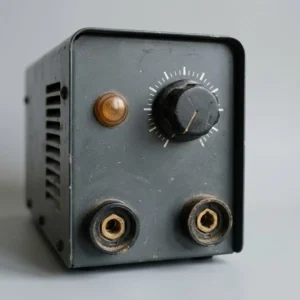
A welder rated for a 30% duty cycle can weld for 3 minutes in every 10 at its rated amps, then has to rest for 7. Turn it down and it runs longer: by the standard estimate, a machine rated 30% at 150 A manages about 67% at 100 A, which is 6.7 minutes in every 10. Enter your own nameplate numbers in the welder duty cycle calculator below to see the weld time, the rest time and the amps you can run without stopping, next to what Miller, Hobart, Lincoln and ESAB manuals say. The duty cycle chart in your own manual wins.
Work out your weld time
Enter the duty cycle on your welder’s nameplate, the amps it is rated at and the amps you plan to weld at. You get the minutes of welding and rest in each 10 minutes, and the amps you can run without stopping.
6.7 min
of welding in each 10 minutes at 100 A, then 3.3 min of rest
- Estimated duty cycle67%At 100 A, from 30% at 150 A.
- Continuous welding82 A or lessNo rest needed, by the same estimate.
- If it cuts outLeave it switched onThe fan cools it. Miller: wait 10 to 15 minutes.
- Shop temperature
- An estimate: the duty cycle chart in your manual wins.
Show the working
- The estimate, from the AWS Welding Handbook: duty cycle at your amps = rated duty cycle × (rated amps ÷ your amps)².
- 30% × (150 A ÷ 100 A)² = 67.5%, shown as 67% (rounded down).
- 67% of 10 minutes is 6.7 min of welding and 3.3 min of rest.
- Continuous welding: 150 A × √(30 ÷ 100) = 82.2 A, shown as 82 A (rounded down).
- Duty cycle is the part of a 10-minute period a welder can run at a given output without overheating: Miller’s, Hobart’s, Lincoln’s and ESAB’s manuals all rate it that way. ESAB and Miller state it for air up to 104°F (40°C).
- It is an estimate. No maker’s manual we read prints it, and set against makers’ own figures it comes out lower in some cases and higher in others (see the chart below). Where your manual gives a figure, use the manual’s.
- The gun, torch and cables heat up too: Hobart’s manual warns that exceeding duty cycle can damage the unit or the gun.
Welder duty cycle chart
Duty cycle is the part of each 10 minutes a welder can run at a given output without overheating. Miller’s manuals put it this way: the percentage of 10 minutes that the unit can weld at rated load. A 20% welder at its rated amps welds for 2 minutes and rests for 8. The rating belongs to one output: at lower amps the same welder runs longer.
| Duty cycle | Welding in each 10 minutes | Rest in each 10 minutes |
|---|---|---|
| 10% | 1 min | 9 min |
| 15% | 1.5 min | 8.5 min |
| 20% | 2 min | 8 min |
| 25% | 2.5 min | 7.5 min |
| 30% | 3 min | 7 min |
| 35% | 3.5 min | 6.5 min |
| 40% | 4 min | 6 min |
| 50% | 5 min | 5 min |
| 60% | 6 min | 4 min |
| 70% | 7 min | 3 min |
| 80% | 8 min | 2 min |
| 100% | 10 min | None: continuous |
Duty cycle at lower amps
The estimate welding texts give for a duty cycle at other than the rated output: rated duty cycle × (rated amps ÷ your amps)². The chart works it for common ratings, with every figure rounded down. The last column is the output at or below which the estimate gives continuous welding.
| Rated duty cycle | At 90% of rated amps | At 80% of rated amps | At 70% of rated amps | At 60% of rated amps | At 50% of rated amps | Continuous at or below |
|---|---|---|---|---|---|---|
| 20% | 24% | 31% | 40% | 55% | 80% | 44% of rated amps |
| 25% | 30% | 39% | 51% | 69% | Continuous | 50% of rated amps |
| 30% | 37% | 46% | 61% | 83% | Continuous | 54% of rated amps |
| 35% | 43% | 54% | 71% | 97% | Continuous | 59% of rated amps |
| 40% | 49% | 62% | 81% | Continuous | Continuous | 63% of rated amps |
| 50% | 61% | 78% | Continuous | Continuous | Continuous | 70% of rated amps |
| 60% | 74% | 93% | Continuous | Continuous | Continuous | 77% of rated amps |
The estimate against makers’ own figures
No maker’s manual we read prints the formula. Each prints its own duty cycle chart instead, and several give a second or third point on it. Here is each of those points next to what the estimate gives from the rated output.
They do not agree. Of the 16 points, the maker’s figure is the higher one in 11 and the estimate in 4. Where the estimate is higher, it would have you welding longer than the maker says: use the maker’s.
| Welder | Rated output | Maker’s own figure | The estimate there | Which is higher |
|---|---|---|---|---|
| Miller Millermatic 211 (MIG, 240 V) | 150 A at 40% | 100% at 100 A | 90% at 100 A | The maker’s |
| Miller Millermatic 211 (MIG, 120 V on a 20 A circuit) | 115 A at 20% | 100% at 90 A | 32% at 90 A | The maker’s |
| Miller Multimatic 235 (MIG, 240 V) | 235 A at 20% | 60% at 170 A | 38% at 170 A | The maker’s |
| Miller Multimatic 235 (Stick, 240 V) | 200 A at 30% | 60% at 150 A | 53% at 150 A | The maker’s |
| Miller Multimatic 235 (TIG, 240 V) | 210 A at 40% | 60% at 180 A | 54% at 180 A | The maker’s |
| Miller Millermatic 252 (MIG, 208/240 V model) | 250 A at 40% | 60% at 200 A | 62% at 200 A | The estimate: use the maker’s |
| Miller Millermatic 252 (MIG, 240/480/575 V model) | 280 A at 30% | 60% at 200 A | 58% at 200 A | The maker’s |
| Miller Millermatic 252 (MIG, 240/480/575 V model) | 280 A at 30% | 100% at 130 A | 100% at 130 A | They agree |
| Lincoln Invertec V155-S (Stick, 230 V) | 145 A at 30% | 100% at 100 A | 63% at 100 A | The maker’s |
| Lincoln Invertec V155-S (Stick, 120 V on a 30 A circuit) | 100 A at 30% | 100% at 75 A | 53% at 75 A | The maker’s |
| ESAB Rebel EMP 215ic (MIG, 230 V) | 205 A at 25% | 40% at 150 A | 46% at 150 A | The estimate: use the maker’s |
| ESAB Rebel EMP 215ic (MIG, 230 V) | 205 A at 25% | 60% at 125 A | 67% at 125 A | The estimate: use the maker’s |
| ESAB Rebel EMP 215ic (MIG, 230 V) | 205 A at 25% | 100% at 110 A | 86% at 110 A | The maker’s |
| ESAB Rebel EMP 215ic (Stick, 230 V) | 180 A at 25% | 60% at 125 A | 51% at 125 A | The maker’s |
| ESAB Rebel EMP 215ic (Stick, 230 V) | 180 A at 25% | 100% at 100 A | 81% at 100 A | The maker’s |
| Miller Multimatic 220 AC/DC (MIG or flux core (Miller’s buying guide)) | 200 A at 20% | 60% at 105 A | 72% at 105 A | The estimate: use the maker’s |
Every estimate is rounded down. Miller’s 120 V figure is for a 20 A circuit and Lincoln’s for a 30 A circuit, as their manuals mark them. The Multimatic 220 AC/DC figures are from Miller’s buying guide, not a manual.
What the manuals say about overheating
All four makers rate duty cycle over 10 minutes. They differ on what happens when you go past it and on how long to wait. Miller gives two waits in its own manuals: 15 minutes for the Millermatic 211 and 252, and 10 for the Multimatic 235.
| Welder | Rated output (10-minute basis) | Air temperature | When it overheats | Before welding again |
|---|---|---|---|---|
| Miller Millermatic 211 | 150 A at 40% (MIG, 240 V); 115 A at 20% (MIG, 120 V on a 20 A circuit) | — | A thermostat opens, output stops and the cooling fan runs. | Wait 15 minutes. Reduce amperage or duty cycle before welding. |
| Miller Multimatic 235 | 235 A at 20% (MIG, 240 V); 200 A at 30% (Stick, 240 V); 210 A at 40% (TIG, 240 V) | Delivers rated output in air up to 104°F (40°C). | Output stops. | Wait 10 minutes. Reduce amperage or duty cycle before welding again. |
| Miller Millermatic 252 | 250 A at 40% (MIG, 208/240 V model); 280 A at 30% (MIG, 240/480/575 V model) | — | A thermistor opens, output stops and the cooling fan runs. | Wait 15 minutes. Reduce amperage, voltage or duty cycle before welding. |
| Hobart Handler 210 MVP | 150 A at 30% (MIG, 230 V); 90 A at 20% (MIG, 115 V) | — | A thermostat opens, output stops and the cooling fan runs. | Wait 15 minutes. Reduce amperage or duty cycle before welding. |
| Lincoln Invertec V155-S | 145 A at 30% (Stick, 230 V); 100 A at 30% (Stick, 120 V on a 30 A circuit) | Operating range up to 104°F (40°C). | A thermal protector shuts off the output and the Thermal LED lights. | Leave the machine switched on to cool. Weld again when the LED goes out. |
| ESAB Rebel EMP 215ic | 205 A at 25% (MIG, 230 V); 180 A at 25% (Stick, 230 V) | Duty cycle valid for 104°F (40°C). | A self-resetting thermostat interrupts the welding current and an overheating symbol shows on the display. | It resets by itself when the temperature is back to normal. |
Miller’s and Hobart’s manuals carry the same notice: exceeding duty cycle can damage the unit (Hobart adds the gun) and void the warranty. A thermal cut-out is a backstop, not a way to work.
Duty cycle also sets the wire size for a welder’s own circuit: the welder breaker size chart works that out from the same nameplate. Still choosing a machine? See what size welder do I need. The welding cable size chart sizes the leads by duty cycle too, and the MIG welding settings chart and stick welding amperage chart show the amps a job needs.
Quick answers
What does a 20% duty cycle mean?
Two minutes of welding in every 10 at the rated amps, then 8 minutes of rest. Miller’s Millermatic 211 is rated 20% at 115 A on 120 V, and Hobart’s Handler 210 MVP 20% at 90 A on 115 V. Turned down, the same welder runs longer.
How long can I weld at a 30% duty cycle?
Three minutes in every 10 at the rated amps, then 7 minutes of rest. That is how Hobart’s manual shows its Handler 210 MVP at 150 A on 230 V. The rating is for that output only: enter your own amps above to see the time at a lower setting.
How do you calculate duty cycle at lower amps?
Multiply the rated duty cycle by the square of rated amps ÷ your amps. A welder rated 30% at 150 A, run at 100 A: 30% × (150 ÷ 100)² gives 67%, or 6.7 minutes in each 10. The AWS Welding Handbook’s example is a 200 A, 60% machine: 38% at 250 A, and continuous welding at 155 A (154 A here, since this page rounds down).
At what amps can my welder run continuously?
By the estimate, at the rated amps times the square root of the duty cycle: 82 A for a welder rated 30% at 150 A, and 44% of the rated amps for a 20% welder. Makers’ own figures are often higher. Miller lists its Millermatic 211 for continuous welding at 100 A on 240 V where the estimate gives 94 A, and Lincoln its Invertec V155-S at 100 A where the estimate gives 79 A.
Is duty cycle based on 10 minutes or an hour?
Ten minutes. Miller’s, Hobart’s, Lincoln’s and ESAB’s manuals all rate duty cycle over a 10-minute period. A 60% welder at its rated amps welds for 6 minutes and rests for 4.
What happens if I go over the duty cycle?
The welder overheats and its thermal protection cuts the output. In Miller’s and Hobart’s manuals a thermostat opens, output stops and the fan keeps running: wait 10 or 15 minutes, then turn the amps down or weld in shorter spells. Lincoln’s manual says to leave the machine on until its thermal light goes out, and ESAB’s protection resets by itself once the welder has cooled. Miller’s notice is blunt: exceeding duty cycle can damage the unit and void the warranty.
Does a hot shop lower the duty cycle?
The ratings are stated for air up to 104°F (40°C). ESAB’s manual says its duty cycle is valid for that temperature, and Miller’s Multimatic 235 manual says the machine delivers rated output up to it. Above that, expect less weld time. No manual we read gives a figure for hotter air, so none is invented here.
What is a good duty cycle for a welder?
For a home shop, what small machines are rated at is usually enough: Miller’s buying guide says a lower duty cycle will typically cover most jobs in a shop or garage. The welders on this page are rated 20% to 40% at full output, and far higher turned down. Check the amps the rating is given at, not only the percent.
How accurate is the duty cycle formula?
Close on some welders and well off on others. For Miller’s Multimatic 235 it gives 38% at 170 A where Miller’s manual gives 60%. For ESAB’s Rebel EMP 215ic it gives 46% at 150 A where ESAB gives 40%. Treat it as a first guess and go by the chart in your manual.
Can a duty cycle be more than 100%?
No. When the sum comes out above 100%, it means the welder can run without a rest at those amps, not that it has time to spare. The calculator shows it as continuous welding.
The duty cycle chart in your welder’s manual, or on the machine, is the final word. Keep the air vents clear, and do not count on the thermal cut-out: repeated overheating shortens a welder’s life.
- The estimate and its worked example: a note on the American Welding Society’s forum that credits the AWS Welding Handbook, 9th edition, volume 2. We did not open the handbook itself.
- The 10-minute basis, rated outputs, extra duty cycle points and overheating: the owner’s manuals of Miller’s Millermatic 211, Multimatic 235 and Millermatic 252, Hobart’s Handler 210 MVP, Lincoln’s Invertec V155-S and ESAB’s Rebel EMP 215ic. Stated in our own words.
- The 3 minutes on, 7 minutes off example and the thermal overload description: Miller’s article on duty cycle. The Multimatic 220 AC/DC figures and the home shop advice: Miller’s guide to buying a first welder.
- The charts and every “estimate” figure are our own arithmetic from that formula, rounded down.
Numbers compiled from the sources below and last updated on . Spotted a mistake? Tell us.
- American Welding Society forum, “Calculation of Duty Cycle other than rated outputs” (2008): the estimate and its two worked examples, credited there to the AWS Welding Handbook, 9th edition, volume 2
- Miller Electric, “Duty Cycle: What It Is and Why It’s Important” (2024)
- Miller Electric, Millermatic 211 owner’s manual OM-265809C (2016), 4-4 “Duty Cycle And Overheating”
- Miller Electric, Multimatic 235 owner’s manual OM-283935B (2020), 4-4 to 4-11 (specifications, duty cycle and overheating)
- Miller Electric, Millermatic 252 owner’s manual OM-230693T (2026), 3-2 and 4-17 “Duty Cycle And Overheating”
- Hobart Welding Products, Handler 210 MVP owner’s manual OM-260274F (2020), 4-4 to 4-6
- Lincoln Electric, Invertec V155-S operator’s manual IM918 (2022): rated output, welding capability, thermal LED
- ESAB, Rebel EMP 215ic instruction manual 0463 408 001 (2020): technical data, 5.8 “Duty cycle”, 5.9 “Overheating protection”
- Miller Electric, “Buying Your First Welder: A Practical, Informative Guide for Do-It-Yourselfers” (2025)