
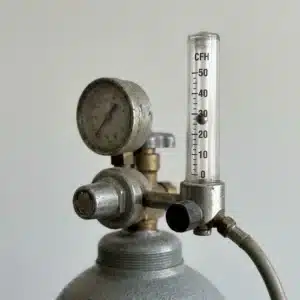
How long does a welding gas tank last? A full 80 cu ft argon tank holds about 86 cu ft: about 4.3 hours of TIG at 20 CFH or 2.9 hours of MIG at 30 CFH, with the arc on. Pick your cylinder, gauge reading and flow below for the hours left, shop time and cost per hour.
How long will your gas last?
Pick what you weld with and your cylinder, then read the gauge (or weigh a CO2 cylinder). You get the hours of welding left, the shop time that adds up to, and the cost per hour.
2.9 hours
of welding with the arc on, at 30 CFH
- Gas left85.6 cu ft (2,015 of 2,015 psi)
- Shop timeAbout 8.2 hours of work in the shop, with the arc on 35% of the time (TWI gives 30–45%)
- Cost
- Usual flow for this process: 30–40 CFH.
How long does a welding gas cylinder last?
Hours of arc time from a full argon or argon-mix cylinder at common flow rates. TIG usually runs at 15–20 CFH and MIG at 30–40 CFH. Contents are Norris Cylinder’s argon figures at 70°F.
| Cylinder | 15 CFH | 20 CFH | 25 CFH | 30 CFH | 35 CFH | 40 CFH | 45 CFH |
|---|---|---|---|---|---|---|---|
| 20 cu ft (18.6 cu ft at 2015 psi) | 1.2 h | 0.9 h | 0.7 h | 0.6 h | 0.5 h | 0.5 h | 0.4 h |
| 40 cu ft (41.5 cu ft at 2015 psi) | 2.8 h | 2.1 h | 1.7 h | 1.4 h | 1.2 h | 1.0 h | 0.9 h |
| 55 cu ft (56.8 cu ft at 2015 psi) | 3.8 h | 2.8 h | 2.3 h | 1.9 h | 1.6 h | 1.4 h | 1.3 h |
| 80 cu ft (85.6 cu ft at 2015 psi) | 5.7 h | 4.3 h | 3.4 h | 2.9 h | 2.4 h | 2.1 h | 1.9 h |
| 125 cu ft (129.5 cu ft at 2265 psi) | 8.6 h | 6.5 h | 5.2 h | 4.3 h | 3.7 h | 3.2 h | 2.9 h |
| 150 cu ft (140.6 cu ft at 2015 psi) | 9.4 h | 7.0 h | 5.6 h | 4.7 h | 4.0 h | 3.5 h | 3.1 h |
| 200 cu ft (202.9 cu ft at 2015 psi) | 13.5 h | 10.1 h | 8.1 h | 6.8 h | 5.8 h | 5.1 h | 4.5 h |
| 250 cu ft (251.4 cu ft at 2265 psi) | 16.8 h | 12.6 h | 10.1 h | 8.4 h | 7.2 h | 6.3 h | 5.6 h |
| 300 cu ft (302.1 cu ft at 2400 psi) | 20.1 h | 15.1 h | 12.1 h | 10.1 h | 8.6 h | 7.6 h | 6.7 h |
| 330 cu ft (the 300 filled to 2640 psi) | 22.1 h | 16.6 h | 13.2 h | 11.0 h | 9.5 h | 8.3 h | 7.4 h |
CO2 cylinders
| CO2 cylinder | Gas when full | At 30 CFH | At 40 CFH | Empty weight |
|---|---|---|---|---|
| 5 lb | 44 cu ft | 1.5 h | 1.1 h | 10.5 lb |
| 20 lb | 176 cu ft | 5.9 h | 4.4 h | 39.0 lb |
| 50 lb | 440 cu ft | 14.7 h | 11.0 h | 90.0 lb |
Quick answers
How long does an 80 cu ft argon tank last?
Full, it holds about 86 cu ft: about 4.3 hours of TIG at 20 CFH, or 2.9 hours of MIG at 30 CFH. With the arc on about a third of the time, that is a day or two of work.
How long does a 125 cu ft gas tank last?
About 130 cu ft when full at 2265 psi: about 6.5 hours of TIG at 20 CFH or 4.3 hours of MIG at 30 CFH.
How long does a 300 cu ft cylinder last?
About 302 cu ft at 2400 psi, or 331 cu ft when filled to 2640 psi (sold as “330”). At 30 CFH that is 10.1 or 11.0 hours of MIG welding.
How many cubic feet are in a 20 lb CO2 tank?
About 176 cu ft: each pound of liquid CO2 makes about 8.8 cu ft of gas at 70°F. At 30 CFH that is about 5.9 hours of welding.
How do I tell how much gas is left?
For argon and argon mixes, the gauge tells you: half the full pressure means about half the gas. For CO2 it doesn’t, because the gas is a liquid inside; weigh the cylinder and subtract its empty weight (about 39 lb for a 20 lb CO2 cylinder).
What flow rate should I use?
About 30–40 CFH for MIG, 15–20 CFH for TIG and 40–50 CFH for flux core with gas. Set it on a flowmeter: more flow is not better, and too much makes turbulence that pulls in air and wastes gas.
Why does my gas run out so fast?
Usually a leak or a flow set too high. Brush soapy water on every fitting and hose with the gas on: bubbles mean a leak. Then check the flowmeter against the usual range for your process.
How many hours of work is that?
More than the arc time. In a typical shop the arc is on only 30–45% of the time for MIG and 25–40% for TIG, not counting set-up, so 3 hours of MIG arc time is roughly 7 to 10 hours of work.
- Cylinder contents: Norris Cylinder, DOT high-pressure cylinder specifications (argon, approximate at 70°F, at the DOT service pressure; the 331 cu ft figure is the 10% overfill DOT allows when its conditions are met). Mixes such as C25 hold a slightly different amount; the cylinder label or your receipt has the exact figure.
- CO2: Engineering ToolBox gives 8.92 cu ft per lb at 77°F, about 8.8 at 70°F. Empty weights: Norris Cylinder.
- Flow: Lincoln Electric (“GMAW: Common MIG Problems and Remedies”, and its VRTEX procedures for flux core with gas) and Miller Electric (“Common TIG Welding Problems”, including the soapy-water leak test).
- Arc-on time by process: TWI Job Knowledge 96, “Welding costs”.
Numbers checked on by Randy Williams against the sources below. Spotted a mistake? Tell us.
- Norris Cylinder, DOT high-pressure cylinder specifications (argon capacity at service pressure, 70°F)
- Norris Cylinder, carbon dioxide cylinder specifications (empty weights)
- Engineering ToolBox, carbon dioxide properties (specific volume)
- Lincoln Electric, “GMAW: Common MIG Problems and Remedies” (MIG gas flow)
- Miller Electric, “Common TIG Welding Problems” (TIG gas flow)
- Lincoln Electric, VRTEX Mobile welding procedure specifications, WC-531 (flux core with gas, 40–50 CFH)
- TWI, Job Knowledge 96, “Welding costs” (arc-on time by process)