
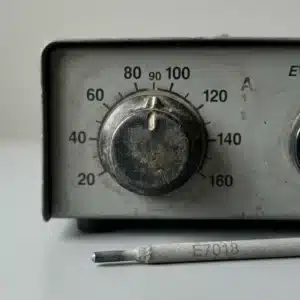
A 1/8 in E7018 rod runs at 90–160 amps on ESAB’s data sheet (115–165 A on the shop chart in Randy’s rod-sticking guide), E6010 and E6011 at 75–125 A and E6013 at 80–130 A. The stick welding amperage chart below gives the range for these and other common electrodes at every diameter from 1/16 to 5/16 in, and compares two rods side by side.
Compare two rods
Pick two stick electrodes and a rod diameter to see how many amps each one needs. The numbers come from the shop chart in Randy’s guide to welding rod sticking; E7018 also has the range from ESAB’s data sheet, listed first.
80–130
90–160
Amperage by rod size
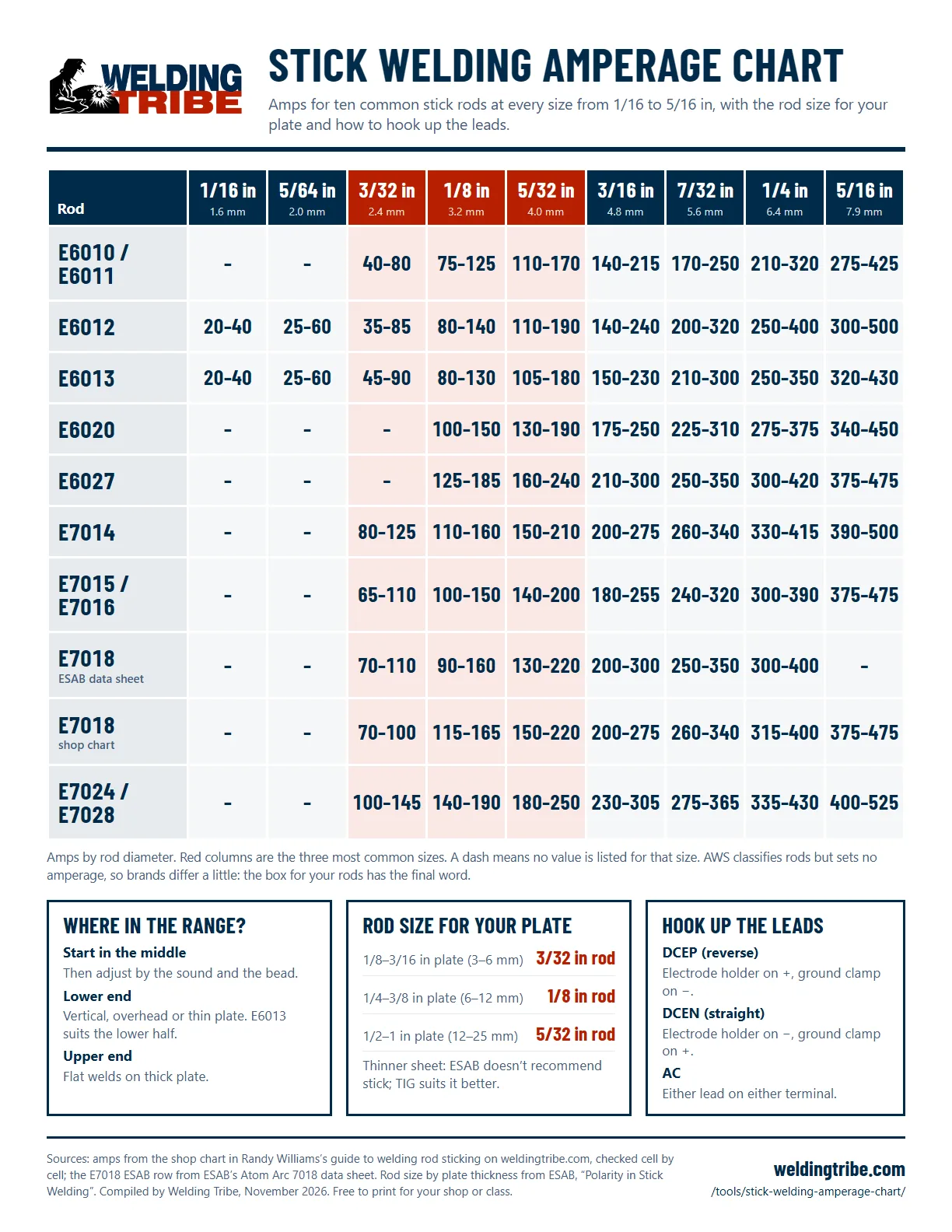
The whole chart: amps for each stick electrode at each rod diameter. E7018 has two columns, ESAB’s data sheet first and the shop chart second. A dash means no value is listed for that size.
Know your plate thickness but not the rod size? Start with stick welding amperage by metal thickness.
| Rod diameter | E6010 / E6011 | E6012 | E6013 | E6020 | E6027 | E7014 | E7015 / E7016 | E7018 (ESAB) | E7018 (shop chart) | E7024 / E7028 |
|---|---|---|---|---|---|---|---|---|---|---|
| 1/16 in (1.6 mm) | not listed | 20–40 | 20–40 | not listed | not listed | not listed | not listed | not listed | not listed | not listed |
| 5/64 in (2.0 mm) | not listed | 25–60 | 25–60 | not listed | not listed | not listed | not listed | not listed | not listed | not listed |
| 3/32 in (2.4 mm) | 40–80 | 35–85 | 45–90 | not listed | not listed | 80–125 | 65–110 | 70–110 | 70–100 | 100–145 |
| 1/8 in (3.2 mm) | 75–125 | 80–140 | 80–130 | 100–150 | 125–185 | 110–160 | 100–150 | 90–160 | 115–165 | 140–190 |
| 5/32 in (4.0 mm) | 110–170 | 110–190 | 105–180 | 130–190 | 160–240 | 150–210 | 140–200 | 130–220 | 150–220 | 180–250 |
| 3/16 in (4.8 mm) | 140–215 | 140–240 | 150–230 | 175–250 | 210–300 | 200–275 | 180–255 | 200–300 | 200–275 | 230–305 |
| 7/32 in (5.6 mm) | 170–250 | 200–320 | 210–300 | 225–310 | 250–350 | 260–340 | 240–320 | 250–350 | 260–340 | 275–365 |
| 1/4 in (6.4 mm) | 210–320 | 250–400 | 250–350 | 275–375 | 300–420 | 330–415 | 300–390 | 300–400 | 315–400 | 335–430 |
| 5/16 in (7.9 mm) | 275–425 | 300–500 | 320–430 | 340–450 | 375–475 | 390–500 | 375–475 | not listed | 375–475 | 400–525 |
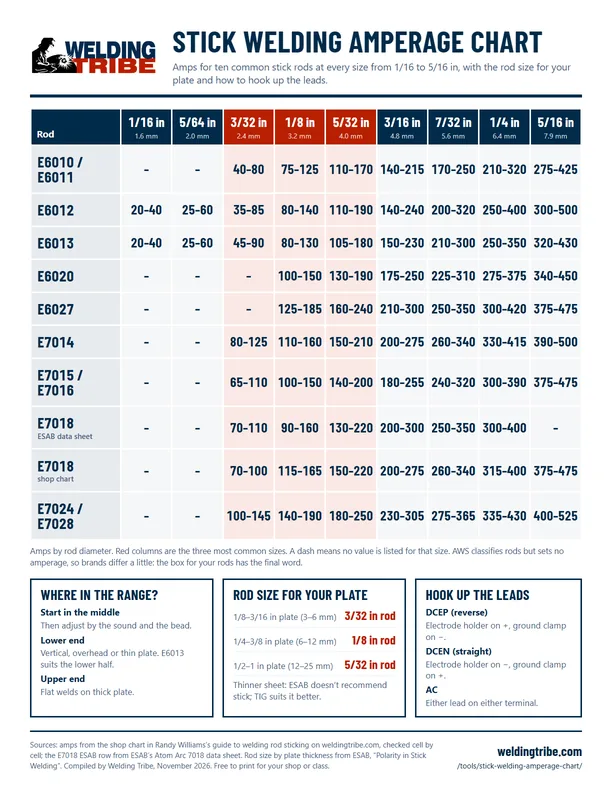
Print it for the shop wall
One page, US Letter (it also prints on A4): this chart for all ten rods at every size, the rod size for your plate and how to hook up the leads. Free, no sign-up.
Quick answers
How many amps for a 1/8 in 7018 rod?
90–160 A on ESAB’s data sheet for its Atom Arc 7018; the shop chart in Randy’s guide gives 115–165 A. Stay near the low end for vertical, overhead or thin plate and nearer the top flat on thick plate, and check the box for your brand.
What amps for 3/32 in rods?
About 70–110 A for E7018 on ESAB’s data sheet (70–100 A on the shop chart), 45–90 A for E6013 and 40–80 A for E6010. 3/32 in is the usual size for 1/8–3/16 in plate.
How many amps for 6013?
45–90 A at 3/32 in and 80–130 A at 1/8 in. E6013 has a soft arc and shallow penetration, made for sheet metal and light parts, so it suits the lower half of the range.
How many amps for 6010 or 6011?
75–125 A for a 1/8 in rod, a little less than E7018. Their deep, digging arc is mostly used for root passes and tacks: E6010 on DCEP, E6011 on AC or DCEP.
What stick welder settings do I use for 7018?
DC electrode positive (it also runs on AC), and 70–110 A for a 3/32 in rod or 90–160 A for 1/8 in on ESAB’s data sheet. Start in the middle of the range and adjust by the sound and the bead.
How many amps for a 1/8 in 7024 rod?
140–190 A, the most of any 1/8 in rod here. E7024 is a heavy, fast-filling rod for flat and horizontal fillets on 1/4 in plate and up.
These are full ranges. Welding vertical or overhead, or on thin metal, stay near the low end; flat on thick plate, near the top.
- The amperage chart in Randy’s guide to welding rod sticking, checked cell by cell: typical ranges by AWS rod class and diameter. AWS classifies the rods but doesn’t set the amps; each maker prints its own range on the box.
- The E7018 (ESAB) column is from ESAB’s Atom Arc 7018: 70–110 A at 3/32 in up to 300–400 A at 1/4 in. Brands differ a little, so check the box or data sheet for your rods too.
Numbers checked by Randy Williams on against the sources below. Spotted a mistake? Tell us.