
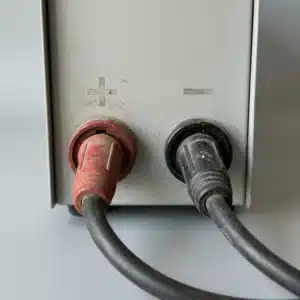
For most stick welding the electrode holder goes on positive and the ground on negative (DCEP): that is how E6010 and E7018 run. The common gasless flux core wire, E71T-11, is the other way round (DCEN, gun on negative). Pick your rod or wire below to see DCEP, DCEN or AC and exactly which lead goes on each terminal, for stick, MIG, flux core and TIG.
Find your polarity
Pick your rod or wire. The answer shows DCEP, DCEN or AC, and which lead goes on the + and − terminals of your welder.
DCEP
E7018: DC electrode positive
- Electrode lead (stinger, torch or gun)Positive (+)
- Work lead (ground clamp)Negative (−)
- Also runs on AC. Also called reverse polarity (DCRP).
Welding polarity chart
Every rod and wire in the tool, with the current it runs on and where each lead goes. Where a rod takes more than one, the first is the usual choice.
| Rod or wire | Current | Electrode lead | Ground clamp | Notes |
|---|---|---|---|---|
| Stick (SMAW) | ||||
| E6010 | DCEP | Positive (+) | Negative (−) | DC electrode positive only. |
| E6011 | DCEP, AC | Positive (+) | Negative (−) | The AC version of E6010. |
| E6012 | DCEN, AC | Negative (−) | Positive (+) | |
| E6013 | DCEP, DCEN, AC | Positive (+) | Negative (−) | DCEN for thin sheet: it penetrates less. |
| E7014 | DCEP, DCEN, AC | Positive (+) | Negative (−) | |
| E7015 | DCEP | Positive (+) | Negative (−) | |
| E7016 | DCEP, AC | Positive (+) | Negative (−) | |
| E7018 | DCEP, AC | Positive (+) | Negative (−) | |
| E7024 | AC, DCEP, DCEN | Either terminal | Either terminal | Usually run on AC. Flat and horizontal fillet welds only. |
| E7028 | DCEP, AC | Positive (+) | Negative (−) | Flat and horizontal fillet welds only. |
| MIG (GMAW), solid wire | ||||
| Steel wire (ER70S-3, ER70S-6) | DCEP | Positive (+) | Negative (−) | With shielding gas. MIG and flux core welders for steel run on DC. |
| Stainless or aluminum wire | DCEP | Positive (+) | Negative (−) | With shielding gas. |
| Flux-cored wire (FCAW) | ||||
| E71T-11, self-shielded (no gas) | DCEN | Negative (−) | Positive (+) | The common gasless hobby wire. Hobart: all T-11 wires run DCEN. |
| E71T-8, self-shielded (no gas) | DCEN | Negative (−) | Positive (+) | |
| E70T-7, self-shielded (no gas) | DCEN | Negative (−) | Positive (+) | Flat and horizontal only. |
| E70T-4, self-shielded (no gas) | DCEP | Positive (+) | Negative (−) | A gasless wire that runs DCEP. Flat and horizontal only. |
| E71T-1, gas-shielded (dual shield) | DCEP | Positive (+) | Negative (−) | Needs shielding gas. |
| E71T-GS, self-shielded (no gas) | See spool | See the spool | See the spool | AWS does not set the polarity for GS wires: use the one printed on the spool. |
| TIG (GTAW) | ||||
| Steel, stainless steel, copper | DCEN | Negative (−) | Positive (+) | DCEN puts most of the heat into the work, not the tungsten. |
| Aluminum, magnesium | AC | Either terminal | Either terminal | AC breaks up the oxide layer on aluminum. |
Quick answers
Is the ground positive or negative when stick welding?
Negative, for most rods. Most stick rods run DCEP: the electrode holder goes on positive (+) and the ground clamp on negative (−). Rods that run DCEN, such as E6012, swap them.
Is E7018 DCEP or DCEN?
E7018 runs on DCEP or AC.
Is E6013 DCEP or DCEN?
E6013 runs on DCEP, DCEN or AC. DCEN for thin sheet: it penetrates less.
Is E6010 DCEP or DCEN?
E6010 runs on DCEP. DC electrode positive only.
Is E6011 DCEP or DCEN?
E6011 runs on DCEP or AC. The AC version of E6010.
What polarity is flux core welding?
It depends on the wire. Gasless self-shielded wires such as E71T-11 and E71T-8 run DCEN, with the ground on positive. Gas-shielded E71T-1 runs DCEP. The spool always says which.
What polarity is MIG welding?
DCEP. With solid wire and shielding gas, the gun goes on positive and the ground clamp on negative. On many MIG welders the gun’s polarity lead sits inside the wire-feed compartment.
What polarity is TIG welding?
DCEN for steel and stainless, with the torch on negative, so most of the heat goes into the work. AC for aluminum and magnesium.
What do DCEP and DCEN mean?
DCEP is direct current, electrode positive, also called reverse polarity. DCEN is direct current, electrode negative, also called straight polarity.
What happens with the wrong polarity?
The rod won’t weld the way it should: ESAB lists poor penetration, excessive spatter and an unstable arc. Check the polarity printed on the box, swap the leads and try again.
Want to see it on a machine? Randy’s guide on how to hook up stick welding leads has photos and diagrams of DCEP, DCEN and AC hookups.
- Stick rods: “Introduction to Welding”, Washington State Board for Community and Technical Colleges (CC BY 4.0), Table 8.2, after AWS A5.1.
- Flux-cored wires: Hobart Brothers, “Choose the Best Flux-Cored Wire” (T-4 DCEP; T-7, T-8 and T-11 DCEN).
- Stick and polarity basics: ESAB, “Polarity in Stick Welding: The Basics for Beginners”.
- When the box, spool or machine says something different, follow it.
Numbers checked on by Randy Williams against the sources below. Spotted a mistake? Tell us.