
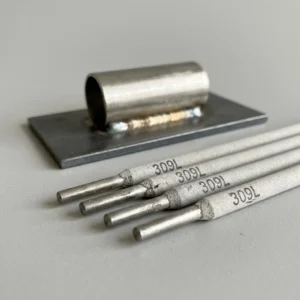
For most jobs a stainless steel welding rod chart comes down to 3 fillers: 308L for 304, 316L for 316, and 309L for stainless to mild steel, where a 1/8 in E309L-16 rod runs at about 60–100 A on Lincoln’s data sheet. Pick your two metals and how you weld below to get the exact stick rod, TIG rod or wire, why it is the pick, and what to watch for.
Which stainless rod or wire?
Pick the two metals you are joining and how you weld. You get the filler to ask for, how to set up, and what to watch for.
E309L-16
309L filler: 304 / 304L to mild steel, stick
- SetupDCEP or ACUse DC when you have it. Hold a short arc.
- HeatLow heat, shallow penetrationSo less mild steel mixes into the weld.
- Second choice
- Also check
- Service stays under about 700°F (371°C)
- Mild steel side painted
- Stainless fume is a cancer hazard: weld with exhaust or a respirator. Your filler maker’s data sheet wins.
Show the working
- 309L is the filler Lincoln, ESAB and Hobart sell for joining stainless to mild or low-alloy steel. It starts at 22–25% chromium and 12–14% nickel, so the weld is still sound after some mild steel melts into it.
- A -16 rod runs on AC or DCEP (electrode positive); Lincoln’s guide says to use DC when you have it. It rates -16 rods for flat work first and for vertical up on DC, with a 5/32 in rod or smaller for vertical and overhead. -17 rods are mainly for flat and horizontal work, and -15 rods are DC only. Hold a short arc. Amps by rod size are in the chart further down.
- Keep the heat input low and the penetration shallow, so less mild steel mixes into the weld (Hobart, Lincoln).
- The mild steel side still rusts: paint it, and carry the paint up to 2 in (50 mm) onto the stainless (ASSDA).
- ESAB rates its 309L rod for this joint up to about 700°F (371°C) in service.
- Fume: welding stainless gives off hexavalent chromium, which OSHA says causes cancer. OSHA’s limit is 5 micrograms per cubic meter of air, averaged over 8 hours (29 CFR 1910.1026), and Lincoln’s data sheets call for special ventilation or local exhaust with these rods.
Stainless steel welding rod chart
The filler for each pair of base metals, written as the stick rod, TIG rod, MIG wire and flux-cored wire to ask for. It is compiled from Lincoln Electric’s filler metal tables and Hobart’s dissimilar welding chart. Galvanized steel counts as mild steel once the zinc is off.
| Joint | Filler | Stick rod | TIG rod | MIG wire | Flux-cored wire |
|---|---|---|---|---|---|
| The same grade on both sides | |||||
| 304 / 304L | 308L | E308L-16 | ER308L | ER308LSi | E308LT1-1/-4 |
| 316 / 316L | 316L | E316L-16 | ER316L | ER316LSi | E316LT1-1/-4 |
| 321 / 347 | 347 (or 308L) | E347-16 | ER347 | ER347Si | E347TX-X |
| 409 | 409 (or 309L) | E309L-16 (309L filler) | ER409 | ER409 | E409TX-X |
| 430 | 430 (or 309L) | E430 | ER430 | ER430 | E430TX-X |
| 410 | 410 (or 309L) | E410 | ER410 | ER410 | E410TX-X |
| Stainless to mild or carbon steel | |||||
| 304 / 304L to mild steel | 309L | E309L-16 | ER309L | ER309LSi | E309LT1-1/-4 |
| 316 / 316L to mild steel | 309L | E309L-16 | ER309L | ER309LSi | E309LT1-1/-4 |
| 321 / 347 to mild steel | 309L | E309L-16 | ER309L | ER309LSi | E309LT1-1/-4 |
| 409 to mild steel | 309L | E309L-16 | ER309L | ER309LSi | E309LT1-1/-4 |
| 430 to mild steel | 309L | E309L-16 | ER309L | ER309LSi | E309LT1-1/-4 |
| 410 to mild steel | 309L | E309L-16 | ER309L | ER309LSi | E309LT1-1/-4 |
| Two different stainless grades | |||||
| 304 / 304L to 316 / 316L | 308L | E308L-16 | ER308L | ER308LSi | E308LT1-1/-4 |
| 304 / 304L to 321 / 347 | 308L (or 347) | E308L-16 | ER308L | ER308LSi | E308LT1-1/-4 |
| 304 / 304L to 409 | 309L | E309L-16 | ER309L | ER309LSi | E309LT1-1/-4 |
| 304 / 304L to 430 | 309L | E309L-16 | ER309L | ER309LSi | E309LT1-1/-4 |
| 304 / 304L to 410 | 309L | E309L-16 | ER309L | ER309LSi | E309LT1-1/-4 |
| 316 / 316L to 321 / 347 | 308L | E308L-16 | ER308L | ER308LSi | E308LT1-1/-4 |
| 316 / 316L to 409 | 309L | E309L-16 | ER309L | ER309LSi | E309LT1-1/-4 |
| 316 / 316L to 430 | 309L | E309L-16 | ER309L | ER309LSi | E309LT1-1/-4 |
| 316 / 316L to 410 | 309L | E309L-16 | ER309L | ER309LSi | E309LT1-1/-4 |
| 321 / 347 to 409 | 309L | E309L-16 | ER309L | ER309LSi | E309LT1-1/-4 |
| 321 / 347 to 430 | 309L | E309L-16 | ER309L | ER309LSi | E309LT1-1/-4 |
| 321 / 347 to 410 | 309L | E309L-16 | ER309L | ER309LSi | E309LT1-1/-4 |
| 409 to 430 | 430 (or 309L) | E430 | ER430 | ER430 | E430TX-X |
| 409 to 410 | 309L | E309L-16 | ER309L | ER309LSi | E309LT1-1/-4 |
| 430 to 410 | 430 (or 309L) | E430 | ER430 | ER430 | E430TX-X |
Reading the names
- L means low carbon: at most 0.04% in an E309L-16 rod, against 0.15% in a plain E309-16 (the AWS limits on Lincoln’s data sheet). Less carbon means fewer chromium carbides forming beside the weld, and those are what let a stainless weld zone corrode. Many rods carry both names, such as E308/E308L.
- The number after the dash on a stick rod is the coating: -15 is lime, for DC only and the pick for vertical and overhead; -16 is titania, for AC or DC; -17 is silica-titania, for AC or DC, mainly flat and horizontal (Lincoln). The chart shows -16 because it runs on AC or DC; the other coatings of the same alloy join the same metals.
- ER308LSi, ER309LSi and ER316LSi have extra silicon, which makes the puddle more fluid and helps it wet out in MIG (Hobart).
- In a flux-cored name such as E309LT1-1, the last digit is the gas: -1 for CO2 and -4 for 75% argon, 25% CO2; T0-3 wires are self-shielded (Lincoln). “TX-X” in this chart stands for those digits: read the spool label.
- Hobart names 312 as the other leading filler for dissimilar joints. It has more ferrite than 309L (over 25 FN against perhaps 7–12), which makes it more crack-resistant, but Hobart says to avoid it where the part runs above 800°F (427°C).
Not sure which lead is DCEP? See the welding polarity chart. Mild steel rod numbers such as E6013 and E7018 are decoded in the welding rod chart.
Fume: welding stainless gives off hexavalent chromium, which OSHA says causes cancer. OSHA’s limit is 5 micrograms per cubic meter of air, averaged over 8 hours (29 CFR 1910.1026). Lincoln’s data sheets call for special ventilation or local exhaust with these rods: keep your head out of the fume, and wear an approved respirator where exhaust can’t keep the air clean.
This chart is for general repair and fabrication. Pressure parts, food-contact work, code work, and duplex, cast or precipitation-hardening stainless need a written welding procedure. Hobart says the same of its own chart: use it as a reference and let the job decide the alloy. Where this chart and your filler maker’s data sheet differ, the data sheet wins.
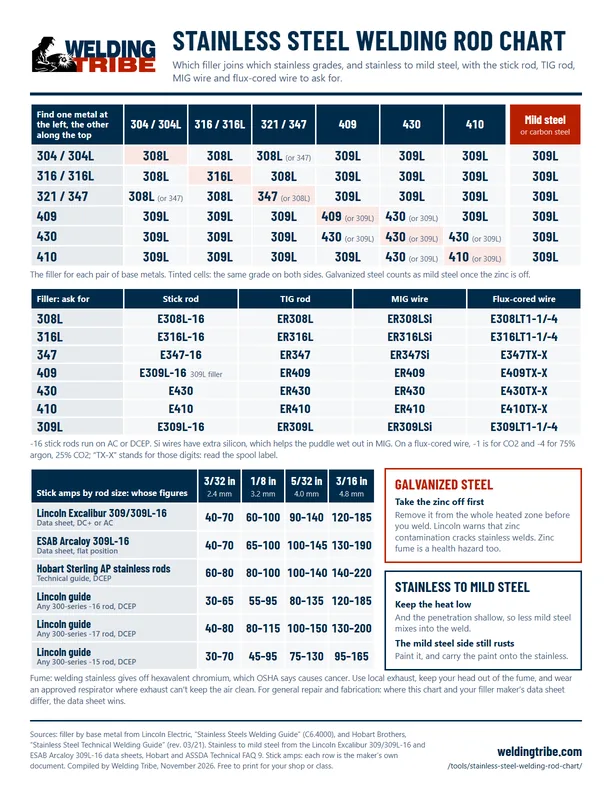
Print it for the shop
One page, US Letter (it also prints on A4): the filler for every pair of stainless grades and for stainless to mild steel, the stick rod, TIG rod, MIG wire and flux-cored wire to ask for, and stick amps by maker. Free, no sign-up.
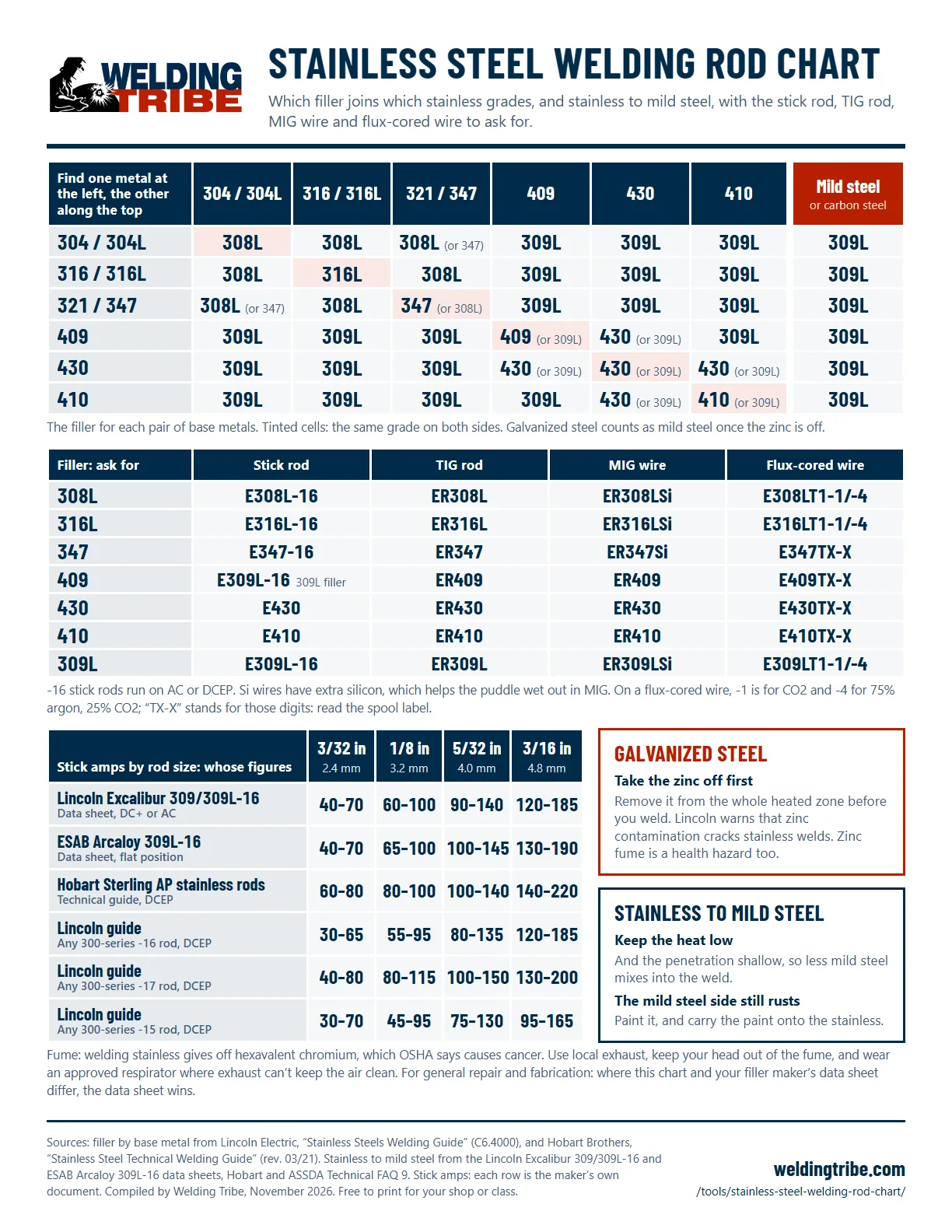
Stick amps for stainless rods, by maker
Stainless needs less current than mild steel, because it holds the heat in the joint instead of carrying it away (Lincoln, Hobart). Each row below is one maker’s own figures. They differ, so the data sheet for the rod in your hand wins.
| Whose figures | 3/32 in (2.4 mm) | 1/8 in (3.2 mm) | 5/32 in (4.0 mm) | 3/16 in (4.8 mm) |
|---|---|---|---|---|
| Lincoln Excalibur 309/309L-16 (data sheet), DC+ or AC | 40–70 A | 60–100 A | 90–140 A | 120–185 A |
| ESAB Arcaloy 309L-16 (data sheet), flat position | 40–70 A | 65–100 A | 100–145 A | 130–190 A |
| Hobart Sterling AP stainless rods (technical guide), DCEP | 60–80 A | 80–100 A | 100–140 A | 140–220 A |
| Lincoln guide: any 300-series -16 rod, DCEP | 30–65 A | 55–95 A | 80–135 A | 120–185 A |
| Lincoln guide: any 300-series -17 rod, DCEP | 40–80 A | 80–115 A | 100–150 A | 130–200 A |
| Lincoln guide: any 300-series -15 rod, DCEP | 30–70 A | 45–95 A | 75–130 A | 95–165 A |
- Lincoln’s guide: for flat welding, aim about 10% under the top of the range. A -16 rod on AC wants about 10% more, and vertical or overhead work takes a 5/32 in rod or smaller.
- ESAB’s vertical figures run lower than its flat ones: 55–70 A for a 1/8 in rod.
These rows are stainless rods only. The shop amperage chart in our guide to why welding rods stick covers mild steel rods, E6010 to E7024, and has no stainless rows. For those rods, use the stick welding amperage chart.
Before you weld stainless
- Clean first. Grind coatings and mill scale back at least 1/2 in (13 mm) on each side of the joint, then wipe it with a solvent such as acetone (Hobart).
- Keep stainless tools for stainless. Lincoln: use stainless steel wire brushes that have only been used on stainless, and no brush or tool that has touched galvanized steel. Zinc and copper contamination both cause cracking.
- Plan for movement. Austenitic stainless (the 300 series) expands about 50% more than carbon steel as it heats (Lincoln, Hobart), so it warps more. Tack it, clamp it, run stringer beads, and keep any weave under 2-1/2 times the rod diameter.
- Fill every crater before you break the arc, so it does not crack (Lincoln).
- A little ferrite in the weld is what stops hot cracking: Lincoln’s guide recommends at least 4 FN. 309L starts with more (9 FN on ESAB’s rod data sheet, 8–14 on Hobart’s wire), and Hobart ties that ferrite to crack resistance in mixed joints.
- Keep rods dry. Lincoln treats stainless rods like low-hydrogen rods: once the can is open, hold them at 200–300°F (93–149°C), and re-dry damp rods at the maker’s temperature, usually 500–600°F (260–316°C) for 1 hour. Mild steel rods are in the welding rod oven temperature chart.
Quick answers
What welding rod do I use for stainless steel to mild steel?
A 309L filler: E309L-16 for stick, ER309L for TIG, ER309LSi for MIG, or E309LT1-1/-4 flux-cored wire. Lincoln, ESAB and Hobart all sell 309L for joining stainless to mild or low-alloy steel, and it is the pick for 304 and 316 alike. It is a higher-alloy filler, so the weld stays sound after some mild steel melts into it.
308 or 309: which rod for 304 stainless to mild steel?
309L (E309L-16). 308L (E308L-16) is the match for 304 welded to 304. Hobart’s guide says never to use 308 between stainless and plain carbon steel: it sometimes works, but once mild steel thins the weld to under about 17% chromium and 7% nickel, it may crack. A 309L rod starts at 22–25% chromium and 12–14% nickel, so it has room to spare.
Can I use 7018 to weld stainless to mild steel?
Not for a weld you need to trust. The Australian Stainless Steel Development Association (ASSDA) says carbon steel must not be welded straight to austenitic stainless: the mixed weld metal turns to martensite, which is brittle and likely to crack as it shrinks. A 7018 or ER70S-6 bead on this joint is that mix. Lincoln’s guide gives the same rule for stainless-clad plate: keep the mild steel electrode from tying into the stainless. Use E309L-16.
Can you weld stainless steel to mild steel, and is it strong?
Yes, with 309L filler (E309L-16 for stick). Hobart’s rule is a filler that matches or slightly beats the weaker of the two metals, and 309L weld metal tests at about 84–85 ksi (580–585 MPa) on Lincoln’s data sheet, against an AWS minimum of 75 ksi (520 MPa). Two limits. ESAB rates its 309L rod for this joint up to about 700°F (371°C) in service. The mild steel side still rusts: paint it, and carry the paint up to 2 in (50 mm) onto the stainless (ASSDA).
308L or 316L: can I use 308L rod on 316 stainless?
Use E316L-16 for 316 to 316. Lincoln’s guide says a modified grade such as 316L takes the same modification in the filler, and 316L carries the molybdenum that helps 316 resist pitting, which 308L lacks. Joining 304 to 316 is different: Hobart’s chart lists 308L (E308L-16) there, the filler of the lower alloy.
How many amps for a 1/8 inch stainless welding rod?
About 60–100 A on Lincoln’s data sheet for its 309L-16 rod, 65–100 A flat on ESAB’s and 80–100 A in Hobart’s guide: follow the sheet for the rod you have. That is well under a mild steel rod of the same size: the shop chart in our guide to why welding rods stick gives 115–165 A for 1/8 in E7018.
What gas do I use to MIG weld stainless? Can I use C25?
Lincoln’s guide gives argon with 1–2% oxygen for spray transfer, and 90% helium, 7.5% argon and 2.5% CO2 for short circuit; Hobart’s wire data sheet lists the same two kinds. C25 is 25% CO2. Lincoln says the CO2 in the gas costs corrosion resistance on multipass short-circuit welds, through carbon pickup, and that straight CO2 is not recommended for solid stainless wire. Gas-shielded flux-cored stainless wire is the exception: it is made to run on CO2 or 75/25.
Do I need to back purge stainless steel?
On an open root with TIG or MIG, yes. TWI says a TIG root pass must always have an inert gas back purge, usually argon. Lincoln’s guide wants an inert gas backup at the root with any gas-shielded process, because oxygen picked up by the hot underside cuts its corrosion resistance and ductility.
Can I weld stainless steel to galvanized steel?
Only after the zinc is off. Remove the zinc from the whole heated zone before you weld galvanized steel. Lincoln warns that zinc contamination cracks stainless welds, and ASSDA calls removing it essential. Zinc fume is a health hazard too. After that it is a stainless to mild steel joint: E309L-16 for stick.
What rod do I use for 409, 410 or 430 stainless?
430 to 430: E430. 410 to 410: E410, with preheat. 409 to 409: ER409 wire, or E309L-16 with a stick welder, since no 409 stick rod is listed. Any of the three to mild steel or to 304: E309L-16. These grades crack or turn brittle more easily than 304, so read the “Watch for” line in the result above.
- Filler by base metal: Lincoln Electric, “Stainless Steels Welding Guide” (publication C6.4000), its filler metal tables for austenitic, ferritic and martensitic stainless, after AWS A5.4, A5.9 and A5.22; Hobart Brothers, “Stainless Steel Technical Welding Guide” (rev. 03/21), its dissimilar welding chart and its table for wrought stainless steels.
- Stainless to mild steel: the Lincoln Excalibur 309/309L-16 and ESAB Arcaloy 309L-16 data sheets, Hobart’s stainless filler metals brochure and its article on how to weld stainless steel, and ASSDA Technical FAQ 9, which cites the Australian standard AS/NZS 1554.6.
- Stick amps: each row is the maker’s own document, named in the row. Hobart’s guide has a second column, for its “Sterling” (-17) rods; it is left out because it does not agree with the guide’s own text on -17 rods.
- Gas, back purging, heat and cleaning: Lincoln’s guide, Hobart’s guide and article, Hobart’s 309/309L wire data sheet and TWI Job Knowledge 104.
- Fume: OSHA’s hexavalent chromium page and 29 CFR 1910.1026.
Numbers compiled from the sources below and last updated on . Spotted a mistake? Tell us.
- Lincoln Electric, Stainless Steels Welding Guide, C6.4000, by Damian Kotecki and Frank Armao (filler metal tables XI–XIII, current ranges in table XVI, welding procedures; read as a distributor’s copy)
- Lincoln Electric, Excalibur 309/309L-16 data sheet (use, AWS limits, typical operating procedures)
- Hobart Brothers, “Stainless Steel Technical Welding Guide”, rev. 03/21 (dissimilar metal guidelines and chart, filler metals for wrought stainless steels, suggested currents)
- Hobart Brothers, “Austenitic (300 Series) Stainless Steel Filler Metals” brochure (what each class is used for)
- Hobart Brothers, “Here’s What You Need to Know About How To Weld Stainless Steel” (309L for 304L to mild steel, cleaning, back purging)
- Hobart Brothers, 309/309L wire data sheet (ferrite number, shielding gases)
- ESAB, Arcaloy 309L-16 data sheet, document CEP-10055, 09/11 (use, service temperature, welding parameters; read as a distributor’s copy)
- Australian Stainless Steel Development Association, Technical FAQ 9, “Welding Dissimilar Metals” (carbon steel to stainless, galvanized steel, painting)
- TWI, Job Knowledge 104, “Welding of austenitic stainless steel, part 2” (back purging, MIG gases)
- OSHA, hexavalent chromium (welding on stainless steel; limit in 29 CFR 1910.1026)
- The mild steel comparison (E7018) is the shop amperage chart in Randy Williams’s “How to Prevent Welding Rod Sticking to The Metal”