
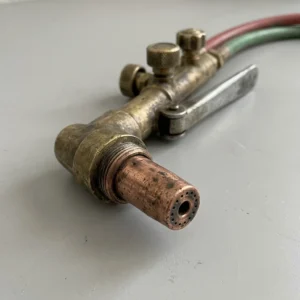
Oxy-acetylene torch settings for cutting 1/2 in steel: a Victor size 0 tip with oxygen at 30–35 psi and acetylene at 3–5 psi, a Harris size 0 with oxygen at 35–40 psi, or a Smith SC12-1 with oxygen at 35 psi and acetylene at 10 psi. Tip numbers and pressures differ by maker, and acetylene never goes above 15 psi. Pick your job, torch maker and steel thickness below for the cutting, welding or rosebud tip size and both regulator settings, plus a check that your acetylene cylinder can keep up.
Your tip and gauge settings
Pick the job, who made your torch and the steel thickness. You get the tip size and both regulator settings from that maker’s chart, plus a check that your acetylene cylinder can keep up with the tip.
- Tip size
- 0
- Oxygen
- 30–35 psi
- Acetylene
- 3–5 psi
Victor (ESAB) cutting tip. Steel: 1/2 in (13 mm).
- Acetylene cylinderLow end onlyTip uses 9–16 cu ft/h; the 1/7 rule allows 10.7.
- Acetylene limit15 psiNever set it higher, with any tip.
- For this tip
- Before you light
- Flashback arrestors and check valves
- Both hoses purged
- Cylinders upright and chained
- Starting points only: your torch maker’s chart wins.
Show the working
- Chart row: Victor 1-101 or 3-101 cutting tip, size 0. Thickness: 1/2 in (13 mm).
- Oxygen 30–35 psi and acetylene 3–5 psi are regulator settings from that maker’s chart.
- Cutting hole: No. 60 drill. Tip numbers differ between makers, so match another brand’s tip by this hole size, then use that brand’s own pressures.
- Acetylene use: 9–16 cu ft per hour.
- Oxygen use: 60–65 cu ft per hour through the cutting jet.
- Travel speed: 16–22 in per minute.
- A 75 cu ft acetylene cylinder can give 10.7 cu ft per hour by the 1/7 rule (Victor, Miller, CGA G-1) and 7.5 by CGA’s stricter 1/10.
- Only the low end of the tip’s range is within 1/7. Its full flow takes 112 cu ft of cylinder capacity: 2 cylinders this size on a manifold, or fewer, bigger ones.
- Lens shade: 3 or darker, OSHA’s minimum for this thickness.
- OSHA bans using acetylene above 15 psig (29 CFR 1910.253(a)(2)).
- Victor says to fit check valves and flashback arrestors if the torch handle has none built in, and to purge each hose before lighting.
Oxy-acetylene cutting tip chart
Tip numbers are not standard between brands. A size 00 cutting tip has a No. 67 hole from Victor, a No. 64 from Harris and a No. 68 from Smith, and each maker runs its tips at its own pressures. So the charts below are kept apart by maker, and each one gives the drill size of the tip’s cutting hole: if your tips are another brand, match that hole size, then use the pressures from that brand’s own chart.
Pressures are regulator settings for acetylene tips. Propane and propylene use different tips and pressures and are not covered here.
Victor cutting tip chart (1-101 and 3-101)
| Steel thickness | Tip size | Oxygen | Acetylene | Acetylene use | Cutting oxygen use | Travel speed | Cutting hole, drill size |
|---|---|---|---|---|---|---|---|
| 1/8 in (3 mm) | 000 | 20–25 psi | 3–5 psi | 6–11 cu ft/h | 20–25 cu ft/h | 20–30 in/min | No. 71 |
| 1/4 in (6 mm) | 00 | 20–25 psi | 3–5 psi | 6–11 cu ft/h | 30–35 cu ft/h | 20–28 in/min | No. 67 |
| 3/8 in (10 mm) | 0 | 25–30 psi | 3–5 psi | 6–11 cu ft/h | 55–60 cu ft/h | 18–26 in/min | No. 60 |
| 1/2 in (13 mm) | 0 | 30–35 psi | 3–5 psi | 9–16 cu ft/h | 60–65 cu ft/h | 16–22 in/min | No. 60 |
| 3/4 in (19 mm) | 1 | 30–35 psi | 3–5 psi | 8–13 cu ft/h | 80–85 cu ft/h | 15–20 in/min | No. 56 |
| 1 in (25 mm) | 2 | 35–40 psi | 3–6 psi | 10–18 cu ft/h | 140–160 cu ft/h | 13–18 in/min | No. 53 |
| 2 in (51 mm) | 3 | 40–45 psi | 4–8 psi | 14–24 cu ft/h | 210–240 cu ft/h | 10–12 in/min | No. 50 |
| 3 in (76 mm) | 4 | 40–50 psi | 5–11 psi | 18–28 cu ft/h | 280–320 cu ft/h | 10–12 in/min | No. 45 |
| 4 in (102 mm) | 5 | 45–55 psi | 6–13 psi | 22–30 cu ft/h | 390–450 cu ft/h | 6–9 in/min | No. 39 |
| 6 in (152 mm) * | 6 | 45–55 psi | 8–14 psi | 25–35 cu ft/h | 500–600 cu ft/h | 4–7 in/min | No. 31 |
| 10 in (254 mm) * | 7 | 45–55 psi | 10–15 psi | 25–35 cu ft/h | 700–850 cu ft/h | 3–5 in/min | No. 28 |
| 12 in (305 mm) * | 8 | 45–55 psi | 10–15 psi | 25–35 cu ft/h | 900–1050 cu ft/h | 3–4 in/min | No. 20 |
- * From tip size 6 up, Victor asks for an HC1200C series torch and 3/8 in hose.
- Victor measures these at the regulator with 25 ft of 1/4 in hose through tip size 5, and 25 ft of 3/8 in hose from size 6. On a two-hose torch the preheat oxygen comes from the cutting oxygen setting.
Harris cutting tip chart (6290 and 6290-S)
| Plate thickness | 6290 tip | 6290-S tip | Oxygen | Acetylene | Cutting hole, drill size |
|---|---|---|---|---|---|
| Up to 3/16 in (5 mm), light gauge | 000 | – | 15–20 psi | 5–15 psi | No. 68 |
| 3/16–3/8 in (5–10 mm) | 00 | – | 20–25 psi | 5–15 psi | No. 64 |
| 3/8–5/8 in (10–16 mm) | 0 | – | 35–40 psi | 5–15 psi | No. 60 |
| 5/8–1 in (16–25 mm) | 1 | 1S | 35–40 psi | 5–15 psi | No. 56 |
| 1–2 in (25–51 mm) | 2 | 2S | 40–45 psi | 5–15 psi | No. 52 |
| 2–3 in (51–76 mm) | 3 | 3S | 45–50 psi | 5–15 psi | No. 48 |
| 3–6 in (76–152 mm) * | 4 | 4S | 50–75 psi | 10–15 psi | No. 42 |
| 6–8 in (152–203 mm) * | – | 5S | 65–80 psi | 10–15 psi | No. 35 |
| 8–12 in (203–305 mm) * | – | 6S | 70–90 psi | 10–15 psi | No. 30 |
- * From size 4 up, Harris asks for 3/8 in hose to carry enough gas.
- Harris gives acetylene as a range: never pass 15 psi. Its chart for these hand tips lists no gas use or travel speed.
Smith cutting tip chart (SC12)
| Steel thickness | Tip | Oxygen | Acetylene | Acetylene use | Oxygen use, cutting + preheat | Travel speed | Cutting hole, drill size |
|---|---|---|---|---|---|---|---|
| 3/16 in (5 mm) | SC12-00 | 20 psi | 10 psi | 6.5 cu ft/h | 24 + 7 cu ft/h | 26 in/min | No. 68 |
| 1/4 in (6 mm) | SC12-0 | 30 psi | 10 psi | 7 cu ft/h | 40 + 7.5 cu ft/h | 22 in/min | No. 62 |
| 3/8 in (10 mm) | SC12-0 | 35 psi | 10 psi | 7 cu ft/h | 50 + 7.5 cu ft/h | 20 in/min | No. 62 |
| 1/2 in (13 mm) | SC12-1 | 35 psi | 10 psi | 9.5 cu ft/h | 75 + 11 cu ft/h | 19 in/min | No. 56 |
| 5/8 in (16 mm) | SC12-1 | 40 psi | 10 psi | 9.5 cu ft/h | 85 + 11 cu ft/h | 17 in/min | No. 56 |
| 3/4 in (19 mm) | SC12-2 | 36 psi | 10 psi | 10.5 cu ft/h | 105 + 12 cu ft/h | 16 in/min | No. 54 |
| 1 in (25 mm) | SC12-2 | 41 psi | 10 psi | 10.5 cu ft/h | 115 + 12 cu ft/h | 14 in/min | No. 54 |
| 1 1/4 in (32 mm) | SC12-2 | 51 psi | 10 psi | 10.5 cu ft/h | 135 + 12 cu ft/h | 13 in/min | No. 54 |
| 1 1/2 in (38 mm) | SC12-3 | 42 psi | 10 psi | 12 cu ft/h | 170 + 14 cu ft/h | 12 in/min | No. 51 |
| 2 in (51 mm) | SC12-3 | 47 psi | 10 psi | 12 cu ft/h | 180 + 14 cu ft/h | 10 in/min | No. 51 |
| 2 1/2 in (64 mm) | SC12-4 | 38 psi | 10 psi | 13 cu ft/h | 240 + 15 cu ft/h | 9 in/min | No. 45 |
| 3 in (76 mm) | SC12-4 | 44 psi | 10 psi | 13 cu ft/h | 265 + 15 cu ft/h | 8 in/min | No. 45 |
| 4 in (102 mm) | SC12-4 | 54 psi | 10 psi | 14 cu ft/h | 315 + 16 cu ft/h | 7 in/min | No. 45 |
| 5 in (127 mm) * | SC12-5 | 56 psi | 10 psi | 26 cu ft/h | 420 + 30 cu ft/h | 7 in/min | No. 41 |
| 6 in (152 mm) * | SC12-5 | 67 psi | 10 psi | 26 cu ft/h | 485 + 30 cu ft/h | 6 in/min | No. 41 |
| 8 in (203 mm) * | SC12-5 | 78 psi | 10 psi | 26 cu ft/h | 550 + 30 cu ft/h | 5.5 in/min | No. 41 |
| 10 in (254 mm) * | SC12-6 | 83 psi | 10 psi | 28 cu ft/h | 750 + 32 cu ft/h | 5 in/min | No. 32 |
| 12 in (305 mm) * | SC12-6 | 125 psi | 10 psi | 28 cu ft/h | 975 + 32 cu ft/h | 4.5 in/min | No. 32 |
- * Miller asks for at least one 350 cu ft acetylene cylinder for this tip.
- Oxygen is the cutting oxygen pressure at the regulator, from Miller’s pocket guide for Smith tips.
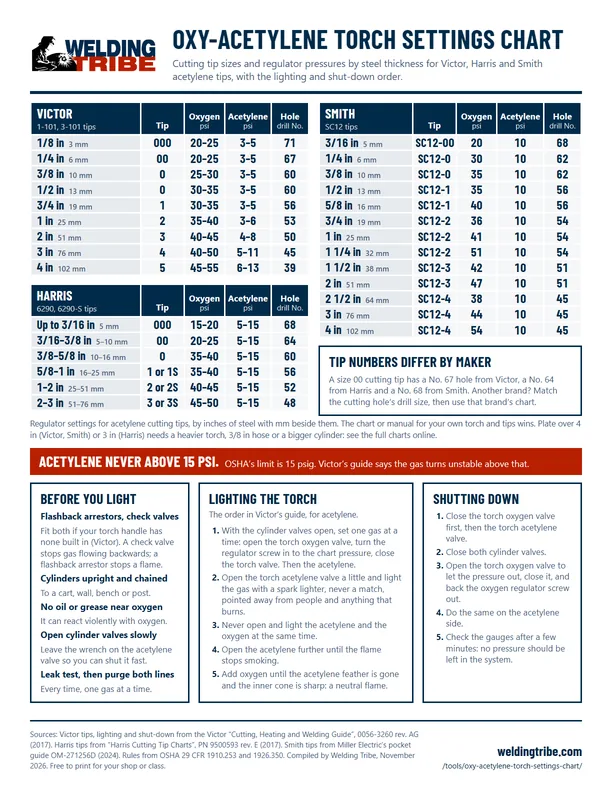
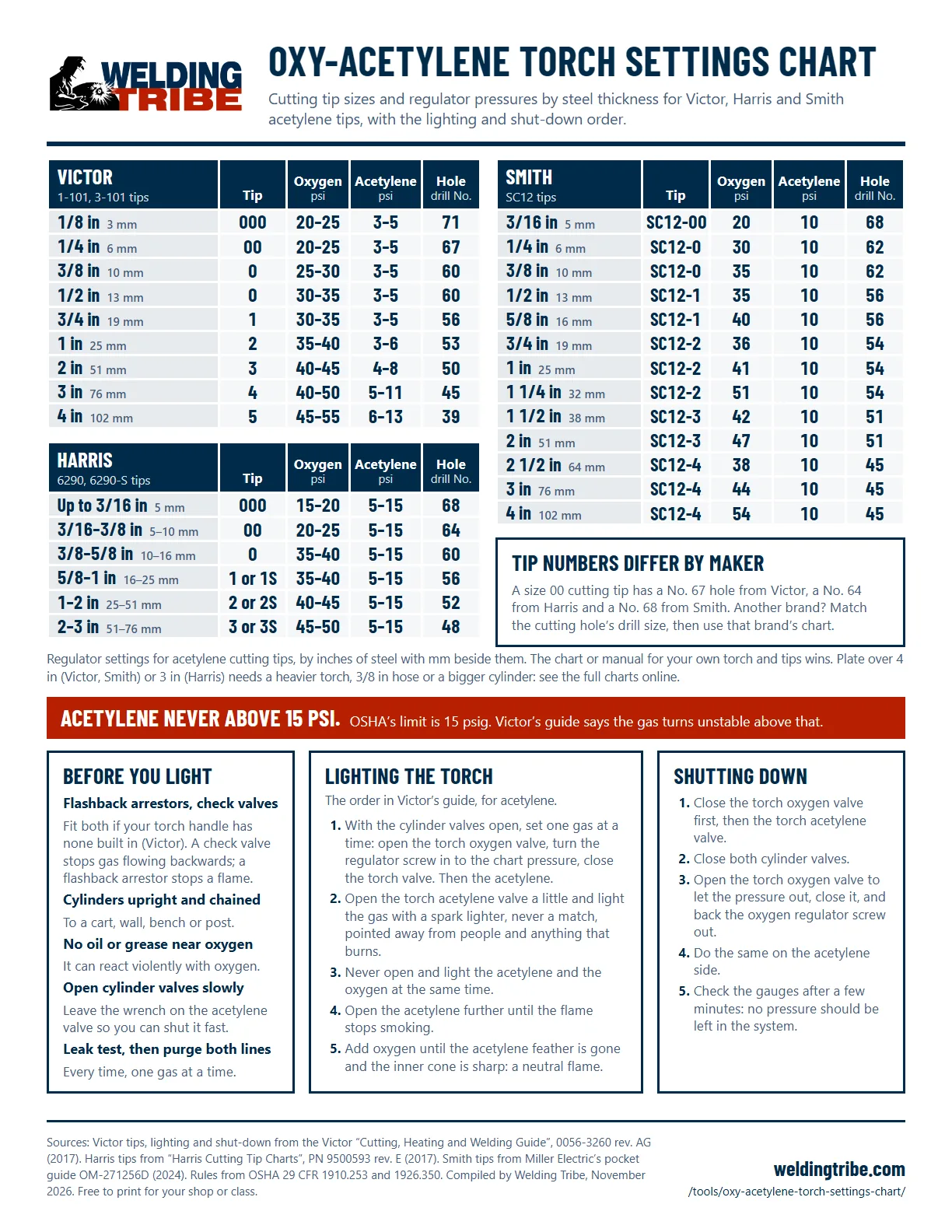
Print it for the torch cart
One page, US Letter (it also prints on A4): Victor, Harris and Smith cutting tips with oxygen and acetylene pressures for steel up to 4 in (3 in for Harris), the 15 psi acetylene limit, and the lighting and shut-down order. Free, no sign-up.
Oxy-acetylene welding and brazing tip chart
Welding tips run both gases at low pressure. Pick the tip by metal thickness. Miller’s table for Smith tips covers welding and brazing; Victor’s is its welding nozzle chart.
Victor welding nozzles
| Metal thickness | Nozzle size | Oxygen | Acetylene | Acetylene use | Orifice, drill size |
|---|---|---|---|---|---|
| Up to 1/32 in (0.8 mm) | 000 | 3–5 psi | 3–5 psi | 1–2 cu ft/h | No. 75 |
| 3/64–1/16 in (1.2–1.6 mm) | 00 | 3–5 psi | 3–5 psi | 1.5–3 cu ft/h | No. 70 |
| 1/32–5/64 in (0.8–2.0 mm) | 0 | 3–5 psi | 3–5 psi | 2–4 cu ft/h | No. 65 |
| 3/64–3/32 in (1.2–2.4 mm) | 1 | 3–5 psi | 3–5 psi | 3–6 cu ft/h | No. 60 |
| 1/16–1/8 in (1.6–3.2 mm) | 2 | 3–5 psi | 3–5 psi | 5–10 cu ft/h | No. 56 |
| 1/8–3/16 in (3.2–4.8 mm) | 3 | 4–7 psi | 3–6 psi | 8–18 cu ft/h | No. 53 |
| 3/16–1/4 in (4.8–6.4 mm) | 4 | 5–10 psi | 4–7 psi | 10–25 cu ft/h | No. 49 |
| 1/4–1/2 in (6.4–12.7 mm) | 5 | 6–12 psi | 5–8 psi | 15–35 cu ft/h | No. 43 |
| 1/2–3/4 in (12.7–19 mm) | 6 | 7–14 psi | 6–9 psi | 25–45 cu ft/h | No. 36 |
| 3/4–1 1/4 in (19–32 mm) | 7 | 8–16 psi | 8–10 psi | 30–60 cu ft/h | No. 30 |
| 1 1/4–2 in (32–51 mm) | 8 | 10–19 psi | 9–12 psi | 35–75 cu ft/h | No. 29 |
| 2 1/2–3 in (64–76 mm) | 10 | 12–24 psi | 12–15 psi | 50–100 cu ft/h | No. 27 |
| 3 1/2–4 in (89–102 mm) * | 12 | 18–28 psi | 12–15 psi | 80–160 cu ft/h | No. 25 |
- * Victor asks for the HD310C torch and 3/8 in hose for this nozzle.
- The thickness ranges overlap as Victor prints them. Victor’s row for size 00 reads “1/16 – 3/64”; it is shown here as 3/64–1/16 in.
Smith welding and brazing tips
| Metal thickness | Tips | Oxygen and acetylene, each | Gas use | Orifice, drill size |
|---|---|---|---|---|
| Up to 1/32 in (0.8 mm) | SW201, MW201, AW201 | 10 psi | 2.3 cu ft/h | No. 71 |
| 5/64 in (2 mm) | SW203, MW203, AW203 | 10 psi | 3.2 cu ft/h | No. 67 |
| 1/8 in (3 mm) | SW205, MW205, AW205 | 10 psi | 6 cu ft/h | No. 57 |
| 3/16 in (5 mm) | SW207, MW207, AW207 | 10 psi | 12 cu ft/h | No. 54 |
| 3/8 in (10 mm) | SW209, MW209, AW209 | 10 psi | 23 cu ft/h | No. 49 |
| 1/2 in (13 mm) * | SW210, AW210 | 10 psi | 36 cu ft/h | No. 44 |
- * Miller lists 15 psi of each gas for the SW210 tip and 10 psi for the AW210. 15 psi is the acetylene limit: never go above it.
- Miller lists one gas use figure for each tip. This page treats it as the acetylene use when it checks the cylinder.
Rosebud heating tip pressure chart
A rosebud burns far more acetylene than a cutting or welding tip, so the cylinder matters as much as the gauges. The capacity column is the acetylene the tip needs behind it at full flow by the 1/7 rule: one cylinder that size, or several on a manifold that add up to it. Never starve a heating tip to make a small cylinder do: Victor warns that a starved tip overheats and can backfire.
Victor MFA heating nozzles
| Nozzle | Acetylene | Oxygen | Acetylene use | Oxygen use | Cylinder capacity for full flow |
|---|---|---|---|---|---|
| MFA size 4 | 6–10 psi | 8–12 psi | 6–20 cu ft/h | 7–22 cu ft/h | 140 cu ft |
| MFA size 6 | 8–12 psi | 10–15 psi | 14–40 cu ft/h | 15–44 cu ft/h | 280 cu ft |
| MFA size 8 | 10–15 psi | 20–30 psi | 30–80 cu ft/h | 33–88 cu ft/h | 560 cu ft |
| MFA size 10 | 12–15 psi | 30–40 psi | 40–100 cu ft/h | 44–110 cu ft/h | 700 cu ft |
| MFA size 12 * | 12–15 psi | 50–60 psi | 60–150 cu ft/h | 66–165 cu ft/h | 1,050 cu ft |
| MFA size 15 * | 12–15 psi | 50–60 psi | 90–220 cu ft/h | 99–244 cu ft/h | 1,540 cu ft |
- * Victor asks for the HD310C torch and 3/8 in hose for this nozzle.
Smith heating tips
| Tip | Acetylene | Oxygen | Acetylene use | Oxygen use | Cylinder capacity for full flow | 350 cu ft cylinders, per Miller |
|---|---|---|---|---|---|---|
| ST602 (6 flames) | 15 psi | 15 psi | 28 cu ft/h | 31 cu ft/h | 196 cu ft | 1 |
| ST603 (6 flames) | 15 psi | 15 psi | 50 cu ft/h | 55 cu ft/h | 350 cu ft | 1 |
| ST605 (12 flames) | 15 psi | 15 psi | 87 cu ft/h | 96 cu ft/h | 609 cu ft | 2 |
| ST610 (12 flames) | 15 psi | 15 psi | 136 cu ft/h | 150 cu ft/h | 952 cu ft | 3 |
| MT603 (6 flames) | 15 psi | 15 psi | 28 cu ft/h | 31 cu ft/h | 196 cu ft | 1 |
| MT605 (6 flames) | 15 psi | 15 psi | 51 cu ft/h | 57 cu ft/h | 357 cu ft | 1 |
| MT610 (12 flames) | 15 psi | 15 psi | 90 cu ft/h | 100 cu ft/h | 630 cu ft | 2 |
| AT605 (6 flames) | 15 psi | 15 psi | 29 cu ft/h | 32 cu ft/h | 203 cu ft | 1 |
- Miller lists 15 psi for both gases, read with the gas flowing. That is the acetylene limit: never go above it.
- Miller’s figures are for 25 ft of 1/4 in hose. It says to make sure any add-on flashback arrestor can pass enough gas for the tip.
Will my acetylene cylinder keep up?
Acetylene is dissolved in acetone inside the cylinder. Draw it out too fast and acetone comes out with the gas. Victor (ESAB) and Miller (Smith) both say never to take more than 1/7 of the cylinder’s capacity per hour. CGA G-1, the gas industry’s acetylene standard, calls 1/7 generally acceptable for welding and cutting and gives stricter figures where acetone in the gas matters: 1/10 per hour for on-and-off use and 1/15 for steady use.
| Acetylene cylinder | 1/7 rule | 1/10, on-and-off use | 1/15, steady use |
|---|---|---|---|
| 10 cu ft | 1.4 cu ft/h | 1 cu ft/h | 0.7 cu ft/h |
| 40 cu ft | 5.7 cu ft/h | 4 cu ft/h | 2.7 cu ft/h |
| 60 cu ft | 8.6 cu ft/h | 6 cu ft/h | 4 cu ft/h |
| 75 cu ft | 10.7 cu ft/h | 7.5 cu ft/h | 5 cu ft/h |
| 100 cu ft | 14.3 cu ft/h | 10 cu ft/h | 6.7 cu ft/h |
| 130 cu ft | 18.6 cu ft/h | 13 cu ft/h | 8.7 cu ft/h |
| 190 cu ft | 27.1 cu ft/h | 19 cu ft/h | 12.7 cu ft/h |
| 225 cu ft | 32.1 cu ft/h | 22.5 cu ft/h | 15 cu ft/h |
| 290 cu ft | 41.4 cu ft/h | 29 cu ft/h | 19.3 cu ft/h |
| 300 cu ft | 42.9 cu ft/h | 30 cu ft/h | 20 cu ft/h |
| 330 cu ft | 47.1 cu ft/h | 33 cu ft/h | 22 cu ft/h |
| 360 cu ft | 51.4 cu ft/h | 36 cu ft/h | 24 cu ft/h |
| 390 cu ft | 55.7 cu ft/h | 39 cu ft/h | 26 cu ft/h |
The cylinder gauge is a poor guide to how much acetylene is left. CGA’s example: a cylinder at 250 psi at 70°F reads under 100 psi at 0°F with no gas used. Suppliers measure the contents by weight, at 14.7 cu ft of acetylene per pound.
For argon, C25 and CO2 shielding gas cylinders, use the welding gas cylinder calculator.
How to set oxy-acetylene regulators safely
- Acetylene never above 15 psi. OSHA bans using acetylene at more than 15 psig (29 CFR 1910.253(a)(2)). Victor’s guide says the gas turns unstable above that.
- Flashback arrestors and check valves. Victor says to fit reverse-flow check valves, and flashback arrestors too, if your torch handle has none built in, and to test check valves at least every six months. They are different parts: a check valve stops gas flowing backwards, a flashback arrestor stops a flame.
- Cylinders upright and chained. OSHA wants fuel-gas cylinders valve end up in use (1910.253(b)(5)(iii)(A)) and a cylinder truck, chain or other steadying device to keep them from being knocked over (1926.350(a)(7)). Victor says to chain each cylinder to a cart, wall, bench or post.
- No oil or grease near oxygen. OSHA says to keep cylinders, valves, regulators, hose and fittings free of oil and grease and never to handle oxygen gear with oily hands or gloves (1910.253(b)(5)(i)). Victor warns that oil or grease can react violently with oxygen.
- Open cylinder valves slowly, from the side. Back both regulator screws out first and stand with the cylinder between you and the regulator. Open the oxygen valve slowly, then all the way. Open the acetylene valve about 3/4 of a turn and never more than 1 1/2 turns, and leave the wrench on it so you can shut it fast (Victor; OSHA 1910.253(b)(5)(iii)).
- Test for leaks, then purge both lines. Victor says the system must be leak tested before lighting. Then purge each line before you light, every time, even after a short shut-down: one gas at a time, in a well ventilated place, with the torch valve open half a turn for 10 seconds per 25 ft of hose with tips up to size 3, or 5 seconds with size 4 and larger.
- Wear the right shade. Victor’s guide asks for goggles of shade 5 or darker. OSHA’s minimum shades for gas welding and torch cutting by thickness are in the welding shade chart.
Lighting the torch
This is the order in Victor’s guide, for acetylene. The manual for your own torch wins if it differs.
- With the cylinder valves open, set one gas at a time. Open the torch oxygen valve, turn the oxygen regulator screw in to the chart pressure, then close the torch valve. Do the same with the acetylene. On a cutting attachment, open the handle’s oxygen valve all the way, set the oxygen with the preheat valve on the attachment, and press the cutting lever for a moment to clear it.
- Open the torch acetylene valve about 1/8 of a turn and light the gas with a spark lighter, never a match (OSHA 1926.350(g)(3)). Point the flame away from people and anything that burns.
- Never open and light the acetylene and the oxygen at the same time.
- Open the acetylene further until the flame stops smoking.
- Add oxygen until the acetylene feather is gone and the inner cone is sharp: that is a neutral flame. A feather left past the cone means too much acetylene (a carburizing flame). On a cutting torch, press the lever and trim the preheat flames back to neutral.
Shutting down
- Close the torch oxygen valve first (the preheat oxygen valve on a cutting attachment), then the torch acetylene valve. Victor says closing the acetylene first can make a pop that throws soot back into the torch.
- Close both cylinder valves.
- Open the torch oxygen valve to let the pressure out (press the cutting lever too), close it, and back the oxygen regulator screw out.
- Do the same on the acetylene side.
- Check the gauges after a few minutes: no pressure should be left in the system.
Quick answers
What should my oxygen and acetylene gauges be set at for cutting?
It depends on the tip and on who made the torch. For 1/2 in steel: a Victor size 0 tip with oxygen at 30–35 psi and acetylene at 3–5 psi; a Harris size 0 with oxygen at 35–40 psi and acetylene at 5–15 psi; a Smith SC12-1 with oxygen at 35 psi and acetylene at 10 psi. Acetylene never goes above 15 psi.
What size tip to cut 1/2 inch steel?
A Victor size 0, a Harris size 0 or a Smith SC12-1. Tip numbers are not standard between brands, so with other tips match the cutting hole instead: a No. 60 drill on the Victor, No. 60 on the Harris and No. 56 on the Smith.
What size tip and pressure to cut 1/4 inch steel?
A Victor size 00 with oxygen at 20–25 psi, a Harris size 00 at 20–25 psi or a Smith SC12-0 at 30 psi. Victor lists a travel speed of 20–28 in per minute at this thickness.
What pressure for a rosebud heating tip?
Victor’s size 6 MFA rosebud runs acetylene at 8–12 psi and oxygen at 10–15 psi and burns 14–40 cu ft per hour of acetylene. Smith’s ST603 runs both gases at 15 psi and burns 50 cu ft per hour. At full flow, the 1/7 rule calls for at least 280 cu ft of cylinder capacity for the Victor and 350 cu ft for the Smith.
Will my acetylene tank run a rosebud?
Compare the tip’s acetylene use with 1/7 of the cylinder’s capacity per hour. A 75 cu ft cylinder can give 10.7 cu ft per hour and a 130 cu ft cylinder 18.6. Victor’s smallest MFA rosebud, size 4, uses 6–20 cu ft per hour, so it needs at least 140 cu ft of cylinder capacity to run at full flow. Bigger tips need cylinders joined on a manifold.
Why can’t I set acetylene above 15 psi?
Acetylene gas turns unstable when it is compressed above 15 psi outside the cylinder, so OSHA bans using it at more than 15 psig. No tip on these charts asks for more. If a big tip starves at 15 psi, it needs more gas flow, not more pressure: a bigger cylinder, cylinders on a manifold, or the 3/8 in hose the maker’s chart asks for.
How far do I open the acetylene cylinder valve?
About 3/4 of a turn, and never more than 1 1/2 turns, so you can shut it fast. Leave the wrench on the valve while you work. The oxygen cylinder valve is different: open it slowly, then all the way.
Which do I shut off first, oxygen or acetylene?
Victor’s guide says to close the torch oxygen valve first, then the acetylene valve: closing the acetylene first can make a pop that throws soot back into the torch. Then close both cylinder valves, bleed each line and back out the regulator screws. If the manual for your torch gives another order, follow it.
Why is my cutting torch leaving a rough cut or slag?
Check four things from the makers’ cut charts. A dirty tip bends the oxygen stream and leaves extra slag and a ragged face (Harris). Moving too fast leaves slag on the bottom edge and drag lines that slant back (Victor). A tip held too high, or too much oxygen pressure, blows away or dishes the top edge (Victor). Too much preheat rounds the top edge and only wastes gas (Harris).
What shade lens for a cutting torch or gas welding?
OSHA’s minimum is shade 3 for cutting steel under 1 in thick and shade 4 for 1 to 6 in. For gas welding it is shade 4 under 1/8 in, shade 5 from 1/8 to 1/2 in and shade 6 over 1/2 in. Victor’s guide asks for shade 5 or darker. See the welding shade chart for every process.
- Victor tips, the 1/7 rule, set-up, lighting, shut-down and cut faults: The ESAB Group, Victor “Cutting, Heating and Welding Guide”, manual 0056-3260 rev. AG (2017), sections 3 to 9.
- Harris tips: The Harris Products Group, “Harris Cutting Tip Charts”, PN 9500593 rev. E (2017), 6290 and 6290-S tips for oxy-acetylene. The size 0 and size 1 rows both print 35–40 psi oxygen; they are shown as printed.
- Smith tips: Miller Electric, “Tips: Cutting, Heating, Welding, Oxy-Acetylene” pocket guide OM-271256D (2024), tables 1, 5 and 6, and Miller’s “Fuel Gas Cylinder Tip Capacity” data sheet for the 1/7 rule.
- Withdrawal rates, valve opening and cylinder contents: Compressed Gas Association, CGA G-1-2009 “Acetylene”, sections 6.2 and 6.3.
- Rules: OSHA 29 CFR 1910.253 (15 psig limit, cylinders, valves, oil and grease) and 29 CFR 1926.350 (securing cylinders, lighting torches).
- These are the makers’ starting points for their own tips. Longer or smaller hose, check valves and add-on arrestors all drop the pressure at the torch. Tips from another brand, or copies, can need different settings: the chart or manual for your own torch and tips wins.
Numbers compiled from the sources below and last updated on . Spotted a mistake? Tell us.
- The ESAB Group, Victor “Cutting, Heating and Welding Guide: Set-up and Safe Operating Procedures”, manual 0056-3260 rev. AG (2017): tip charts, the 1/7 withdrawal rule, set-up, lighting and shut-down
- The Harris Products Group, “Harris Cutting Tip Charts”, PN 9500593 rev. E (2017): 6290 and 6290-S tips for oxy-acetylene
- Miller Electric (Smith), “Tips: Cutting, Heating, Welding, Oxy-Acetylene” pocket guide, OM-271256D (2024): SC12 cutting tips, welding and brazing tips, heating tips
- Miller Electric, “Fuel Gas Cylinder Tip Capacity” technical data (acetylene withdrawal rates)
- Compressed Gas Association, CGA G-1-2009 “Acetylene”, sections 6.2 and 6.3 (withdrawal rates, valve opening, cylinder contents)
- OSHA 29 CFR 1910.253, oxygen-fuel gas welding and cutting (15 psig limit, cylinders and valves, oil and grease)
- OSHA 29 CFR 1926.350, gas welding and cutting (securing cylinders, lighting torches)