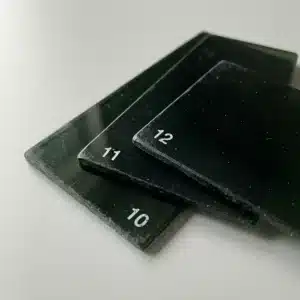
For stick welding at 60–160 amps the American Welding Society recommends shade 10–12, and OSHA’s minimum is shade 8; MIG at the same current also takes 10–12. Pick your process and amps below for the recommended range and the minimum, for stick, MIG, flux core, TIG, plasma cutting and gas work.
Find your lens shade
Pick your process and the amps you weld at (or the plate thickness for gas work). You get OSHA’s minimum shade, the range the American Welding Society recommends and the ANSI Z49.1 comfort shade.
Shade 10–12
Recommended shade (AWS): Stick (SMAW), 60–160 A (3/32–5/32 in rods)
- OSHA minimumShade 8. Never go lighter.
- ANSI Z49.1 suggestsShade 10
- OSHA’s rule of thumb: start with a shade too dark to see the weld zone, then go lighter until you can see it well, never below the minimum.
Welding shade chart
OSHA’s minimum protective shade for each process and current, the American Welding Society’s recommended range where its chart gives one, and the comfort shade ANSI Z49.1 suggests where it gives one.
| Current or plate | Minimum shade (OSHA) | Recommended (AWS) | Suggested (ANSI Z49.1) |
|---|---|---|---|
| Stick (SMAW) | |||
| under 60 A (rods under 3/32 in) | 7 | – | – |
| 60–160 A (3/32–5/32 in rods) | 8 | 10–12 | 10 |
| 160–250 A (5/32–1/4 in rods) | 10 | 12–14 | 12 |
| 250–550 A (rods over 1/4 in) | 11 | 12–14 | 14 |
| MIG or flux core (GMAW, FCAW) | |||
| under 60 A | 7 | 7–10 | – |
| 60–160 A | 10 | 10–12 | 11 |
| 160–250 A | 10 | – | 12 |
| 250–500 A | 10 | – | 14 |
| TIG (GTAW) | |||
| under 50 A | 8 | 8–10 | 10 |
| 50–150 A | 8 | 10–12 | 12 |
| 150–500 A | 10 | 12–14 | 14 |
| Plasma cutting | |||
| light, under 60 A | 8 | 9–14 | – |
| light, 60–80 A | 8 | 9–14 | 8 |
| light, 80–300 A | 8 | 9–14 | 9 |
| medium, 300–400 A | 9 | 9–14 | 12 |
| heavy, 400–800 A | 10 | 9–14 | 14 |
| Plasma arc welding | |||
| under 20 A | 6 | – | 6–8 |
| 20–100 A | 8 | – | 10 |
| 100–400 A | 10 | – | 12 |
| 400–800 A | 11 | – | 14 |
| Air carbon arc cutting | |||
| light, under 500 A | 10 | – | 12 |
| heavy, 500–1000 A | 11 | – | 14 |
| Gas welding (oxy-fuel) | |||
| plate under 1/8 in (3.2 mm) | 4 | – | 4 or 5 |
| plate 1/8–1/2 in (3.2–12.7 mm) | 5 | – | 5 or 6 |
| plate over 1/2 in (12.7 mm) | 6 | – | 6 or 8 |
| Oxygen cutting (torch) | |||
| plate under 1 in (25 mm) | 3 | 4–6 | 3 or 4 |
| plate 1–6 in (25–150 mm) | 4 | 4–6 | 4 or 5 |
| plate over 6 in (150 mm) | 5 | 4–6 | 5 or 6 |
| Torch brazing | |||
| any | 3 | 4–6 | 3 or 4 |
| Torch soldering | |||
| any | 2 | – | 2 |
| Carbon arc welding | |||
| any | 14 | – | 14 |
These apply where the arc is clearly seen; lighter filters can work when the arc is hidden by the workpiece (OSHA). ANSI Z49.1:2021 lists lighter shades for small cutters (4 under 20 A, 5 at 20–40 A, 6 at 40–60 A), but OSHA’s table still sets 8 below 300 A where the arc is clearly seen.
Quick answers
What shade for stick welding?
Shade 10–12 at 60–160 A and 12–14 above 160 A (AWS); ANSI Z49.1 suggests 10, 12 and 14 as the current rises. Never go below OSHA’s minimum: 7 under 60 A, 8 at 60–160 A, 10 at 160–250 A and 11 at 250–550 A.
What shade for MIG welding?
Shade 10–12 at 60–160 A (AWS) and 7–10 below 60 A; above 160 A, ANSI Z49.1 suggests 12 up to 250 A and 14 up to 500 A. The same goes for flux core. OSHA’s minimum is 7 under 60 A and 10 from 60 to 500 A.
What shade for TIG welding?
Shade 10–12 at 50–150 A, 12–14 above 150 A and 8–10 under 50 A (AWS). OSHA’s minimum is 8 up to 150 A and 10 from 150 to 500 A.
What shade for plasma cutting?
AWS gives shade 9–14. ANSI Z49.1 suggests 8 at 60–80 A, 9 at 80–300 A, 12 at 300–400 A and 14 above, and lists lighter shades (4 to 6) for small cutters under 60 A. OSHA’s minimum where the arc is clearly seen is 8 under 300 A, 9 at 300–400 A and 10 above.
What shade for torch cutting and gas welding?
Gas welding: shade 4 or 5 on plate under 1/8 in, 5 or 6 up to 1/2 in and 6 or 8 above (ANSI Z49.1). Oxygen cutting and torch brazing: shade 4–6 (AWS); ANSI Z49.1 suggests 3 or 4 for cutting under 1 in, 4 or 5 up to 6 in and 5 or 6 above, and 3 or 4 for brazing. Torch soldering: 2.
Is shade 10 dark enough for stick welding?
Below 250 A it meets OSHA’s minimum, though AWS suggests 12–14 above 160 A for comfort. Above 250 A the minimum is 11.
Is a darker shade always safer?
Too light lets harmful light reach your eyes; too dark hides the weld pool and causes mistakes. Start dark, go lighter until you can see well, and never drop below the minimum.
What shade for an auto-darkening helmet?
Set its dark shade from this chart for your process and amps. Auto-darkening helmets let you fine-tune within the recommended range.
- Minimum shades: OSHA 29 CFR 1910.133(a)(5), “Filter Lenses for Protection Against Radiant Energy”, with its footnotes.
- Recommended ranges: American Welding Society, “Complete Welding Lens Shade Chart & Safety Guide for Eye Protection” (Welding Digest, November 2025).
- Suggested comfort shades, where it gives one: ANSI Z49.1, “Safety in Welding, Cutting, and Allied Processes”, and its AWS F2.2 lens shade selector.
- At the edge between two OSHA rows (for example exactly 160 A), the tool uses the darker one.
Numbers checked on by Randy Williams against the sources below. Spotted a mistake? Tell us.
- OSHA 29 CFR 1910.133(a)(5), filter lenses for protection against radiant energy
- American Welding Society, Welding Digest, November 2025, “Complete Welding Lens Shade Chart & Safety Guide for Eye Protection”
- ANSI Z49.1:2021, “Safety in Welding, Cutting, and Allied Processes”, Table 1 (from the AWS F2.2 lens shade selector): suggested comfort shades