
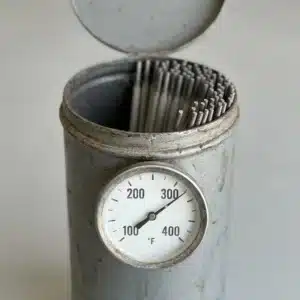
Keep opened 7018 rods in an oven at 250–300°F (120–150°C). Rods left out too long are re-dried at 650–750°F for 1 hour on Lincoln’s chart, and on AWS D1.1 code work E7018 may stay out of the oven 4 hours at most. Pick your rods and what happened to them below for the temperature in °F and °C, and how long.
Oven temperature for your rods
Pick your rods and what happened to them. The answer gives the oven temperature in °F and °C, and how long.
250–300°F
Holding oven or cabinet, once the can is open
- In Celsius120–150°C
- Take out only what you’ll use. AWS D1.1: 4 hours out of the oven at most. Rods marked R (like E7018 H4R) and E7018M are allowed 9 hours.
- Never go above the maker’s temperature and keep low-hydrogen rods in their own oven. AWS D1.1 code work allows one re-bake only; the makers allow up to 3 re-dries elsewhere.
Welding rod oven temperature chart
Storage once the can is open, and re-drying when rods have picked up moisture, by rod family. The re-drying figures are the rod makers’ guidance; the AWS D1.1 code rules follow below.
| Rods | Opened can: store at | Re-dry | Wet rods: pre-dry first | Notes |
|---|---|---|---|---|
| E7018, E7028 | 250–300°F (120–150°C) | 650–750°F (340–400°C), 1 hour | 180–220°F (80–100°C) | Re-dry figures from Lincoln. ESAB holds its low-hydrogen rods at 225–300°F and reconditions them for 1 hour at 700°F. |
| E8018, E9018, E10018, E11018 | 250–300°F (120–150°C) | 700–800°F (370–430°C), 1 hour | 180–220°F (80–100°C) | Re-dry figures from Lincoln, whose chart sets these 50°F higher than E7018. |
| E6012, E6013, E6022, E7014, E7024 | 100–130°F (40–50°C) | 250–300°F (120–150°C), 1 hour | – | A warm, dry cabinet is enough; these rods don’t need a hot oven. |
| E6010, E6011, E7010, E8010 | Dry, room temperature | Not recommended | – | No oven: keep them dry at room temperature. Reconditioning is not recommended. |
AWS D1.1 rules for code work
On structural steel welded to AWS D1.1, these limits apply to low-hydrogen rods on top of the maker’s figures.
| Rods | Time out of the oven |
|---|---|
| E70XX (E7018, E7028) | 4 hours |
| E70XXR, E70XXHZR, E7018M | 9 hours |
| E80XX (E8018) | 2 hours |
| E90XX (E9018) | 1 hour |
| E100XX, E110XX | 30 minutes |
- Opened cans go straight into an oven held at 250°F (120°C) or more.
- Rods left out longer are baked: E7018 and other AWS A5.1 rods at 500–800°F (260–430°C) for at least 2 hours, E8018 and other AWS A5.5 rods at 700–800°F (370–430°C) for at least 1 hour. Load them into an oven no hotter than half the baking temperature, hold 30 minutes, then heat up.
- Rods can be re-baked once only, and rods that got wet are not used.
Shelf life in sealed packaging (ESAB)
| Rods | Hermetically sealed can | Other packages |
|---|---|---|
| Low hydrogen (Atom Arc) | 5 years | – |
| Carbon steel (Sureweld) | 2 years | 1 year |
| Stainless (Arcaloy) | 5 years | 1 year |
Quick answers
What temperature should a 7018 rod oven be?
250–300°F (120–150°C) once the can is open. ESAB holds its low-hydrogen rods at 225–300°F.
How long can 7018 be out of the oven?
4 hours at most for standard E7018 under AWS D1.1. Moisture-resistant rods with R in the name (like E7018 H4R) and E7018M are allowed 9 hours. Higher-strength rods get less: 2 hours for E8018, 1 hour for E9018, 30 minutes for E10018 and E11018.
How do you re-dry 7018 rods?
Spread them out in a rod oven, put them in before it reaches half the re-drying temperature and hold 30 minutes, then hold the re-drying temperature: 650–750°F (340–400°C) for 1 hour on Lincoln’s chart. On AWS D1.1 code work it is 500–800°F (260–430°C) for at least 2 hours, and only once.
Do 6010 and 6011 rods need a rod oven?
No. Keep cellulosic rods dry at room temperature; reconditioning them is not recommended.
Can you re-dry 6013 rods?
Yes: 250–300°F (120–150°C) for 1 hour. Store opened 6013 at 100–130°F.
How many times can you re-dry welding rods?
Once on AWS D1.1 code work. Outside code work, rod makers allow no more than 3 re-dries. Several hours at a lower temperature does not count as a proper re-dry.
What if 7018 rods got wet?
On AWS D1.1 code work they are scrapped. Elsewhere, Lincoln says pre-dry at 180–220°F (80–100°C) first, then re-dry at 650–750°F (340–400°C) for 1 hour.
How long do welding rods last?
In ESAB’s sealed cans: 5 years for low-hydrogen and stainless rods, 2 years for carbon steel rods (1 year in other packages), stored at 50–90°F and 50% humidity.
- The maker figures come from the tables in Randy’s guide to why welding rods need to be heated: Lincoln Electric’s low-hydrogen re-drying chart, ESAB’s storage and shelf-life charts and the storage table by rod family. The code rules come from AWS D1.1, Structural Welding Code – Steel.
- °C values are converted from °F and rounded to 10 degrees, as AWS prints them.
- The rod maker’s instructions on the box come first.
Numbers checked on by Randy Williams against the sources below. Spotted a mistake? Tell us.
- Lincoln Electric, ESAB and storage tables in Randy Williams’s “Why Do Welding Rods Need to Be Heated”, checked cell by cell
- AWS D1.1, Structural Welding Code – Steel: low-hydrogen electrode storage, atmospheric exposure limits and baking