
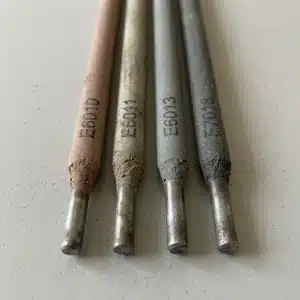
The numbers on a stick rod give its strength, positions and coating: in E7018, 70 means 70,000 psi tensile strength, 1 means all positions and 8 means a low-hydrogen coating that runs on AC or DCEP. Type any stick electrode below to decode it digit by digit, then compare the common rods in the welding rod chart: coating, positions, current and what each one is for.
Decode a welding rod
Type the number printed on the rod or the box. Each part of it tells you something: strength, positions, coating, current and extras like low hydrogen.
E7018
Low-hydrogen potassium, iron powder · All positions · AC, DCEP
- EElectrode for stick welding.
- 70Weld metal strength of at least 70,000 psi.
- 1All positions: flat, horizontal, vertical and overhead.
- 8Low-hydrogen potassium, iron powder coating. Runs on AC, DCEP.
- -1Meets extra toughness (impact) requirements.
- H4Very low hydrogen: no more than 4 mL of diffusible hydrogen per 100 g of weld metal.
- RMoisture resistant: passed the absorbed-moisture test.
Welding rod chart
The common carbon steel stick rods: coating, positions, the current they run on and, for the ones you’ll meet most, what they’re for.
| Rod | Coating | Positions | Current | What it’s for |
|---|---|---|---|---|
| E6010 | High cellulose sodium | All positions | DCEP | Deep, digging arc that freezes fast and copes with rust and dirt. Mostly root passes and tacking. |
| E6011 | High cellulose potassium | All positions | AC, DCEP | Essentially E6010 that also runs on AC. |
| E6012 | High titania sodium | All positions | AC, DCEN | |
| E6013 | High titania potassium | All positions | AC, DCEP, DCEN | Soft arc, shallow penetration, smooth bead. Made for sheet metal and light-duty parts; needs clean metal. |
| E6018 | Low-hydrogen potassium, iron powder | All positions | AC, DCEP | |
| E6019 | Iron oxide titania potassium | All positions | AC, DCEP, DCEN | |
| E6020 | High iron oxide | Flat and horizontal fillet | AC, DCEP, DCEN (flat only) | |
| E6022 | High iron oxide | Flat and horizontal (single pass) | AC, DCEN | |
| E6027 | High iron oxide, iron powder | Flat and horizontal fillet | AC, DCEP, DCEN (flat only) | |
| E7014 | Iron powder, titania | All positions | AC, DCEP, DCEN | |
| E7015 | Low-hydrogen sodium | All positions | DCEP | |
| E7016 | Low-hydrogen potassium | All positions | AC, DCEP | |
| E7018 | Low-hydrogen potassium, iron powder | All positions | AC, DCEP | The workhorse for structural steel: soft arc, moderate penetration, strong and ductile welds. Keep it in a rod oven. |
| E7018M | Low-hydrogen iron powder | All positions | DCEP | E7018 made to military requirements. |
| E7024 | Iron powder, titania | Flat and horizontal fillet | AC, DCEP, DCEN | Fast, heavy fillet welds in the flat and horizontal positions. |
| E7027 | High iron oxide, iron powder | Flat and horizontal fillet | AC, DCEP, DCEN (flat only) | |
| E7028 | Low-hydrogen potassium, iron powder | Flat and horizontal fillet | AC, DCEP | |
| E7048 | Low-hydrogen potassium, iron powder | Flat, horizontal, overhead, vertical down | AC, DCEP |
Quick answers
What does 7018 mean on a welding rod?
E is electrode; 70 means the weld is at least 70,000 psi strong; 1 means all positions; 8 means a low-hydrogen potassium coating with iron powder, run on AC or DCEP.
What does 6011 mean?
60 means at least 60,000 psi (the E60 class), 1 means all positions, and the last 1 a high cellulose potassium coating that runs on AC or DCEP.
What’s the difference between 6011 and 7018?
E6011 has a digging arc that handles rust and dirt and needs no oven. E7018 is stronger (70,000 psi), smoother and low in hydrogen, but needs clean metal and dry storage.
What does H4R mean on 7018?
H4: no more than 4 mL of diffusible hydrogen per 100 g of weld metal. R: the coating passed the absorbed-moisture test, so it resists picking up moisture.
Which rod for rusty or dirty metal?
E6010 or E6011. Their cellulose coating gives a deep, digging arc that is less bothered by rust and surface dirt than E6013 or E7018.
Which rod for thin sheet metal?
E6013. Its soft arc and shallow penetration were made for sheet metal and light-duty steel parts.
Which rods only weld flat and horizontal?
Any rod whose third digit is 2. E7024, E7028, E6020, E6027 and E7027 weld flat and horizontal fillets only; E6022 welds flat and horizontal, single pass only.
Is E7018-1 different from E7018?
Yes: the -1 means it also meets extra toughness (impact) requirements on top of the standard E7018 ones.
- “Introduction to Welding”, Washington State Board for Community and Technical Colleges (CC BY 4.0), section 8.3, after AWS A5.1: strength classes, position digit, coating and current for each rod, the E6010, E6013 and E7018 descriptions, H4 and R.
- AWS A5.1/A5.1M: the strength minimums (E60XX at 60,000 psi), the E6022 positions and the -1 and M suffixes. Alloy letters (A, B, C, D, G, W): AWS A5.5.
- Every box and data sheet lists that rod’s current, positions and amps.
Numbers checked on by Randy Williams against the sources below. Spotted a mistake? Tell us.
- “Introduction to Welding”, Washington State Board for Community and Technical Colleges (CC BY 4.0), section 8.3, after AWS A5.1
- AWS A5.1/A5.1M, carbon steel electrodes for shielded metal arc welding: classification table and tensile requirements