
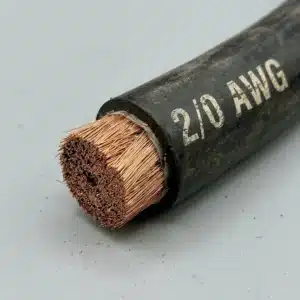
Welding cable size depends on the amps and the total length of both leads. At 200 A and 10–60% duty cycle, 3 AWG copper does up to 100 ft in total on voltage drop (AWS advises 2 AWG as the smallest), 1 AWG up to 150 ft and 1/0 up to 200 ft. Enter your own amps and lengths below for the size that keeps the voltage drop to 4 volts or less.
Find your cable size
Enter the amps you weld at and the length of both leads: the electrode lead and the work (ground) lead. The size keeps the voltage drop to 4 volts or less.
3 AWG
Copper welding cable for 200 A with 50 ft of cable in total
- Size3 AWG (30 mm²)
- Total length25 ft electrode lead + 25 ft work lead = 50 ft. Miller’s 100 ft or less column applies.
- Miller’s table allows this size on voltage drop alone; AWS Fact Sheet No. 39 advises nothing smaller than 2 AWG, for mechanical strength.
- If a cable gets hot in use, go up one size.
Welding cable size chart
Copper welding cable size (AWG) by welding amps and the total length of both leads, from Miller’s owner’s manual table. Sizes keep the drop to 4 volts or less, or at least 300 circular mils per amp.
| Welding amps | 100 ft or less, 10–60% duty | 100 ft or less, 60–100% duty | 150 ft (45 m) | 200 ft (60 m) | 250 ft (70 m) | 300 ft (90 m) | 350 ft (105 m) | 400 ft (120 m) |
|---|---|---|---|---|---|---|---|---|
| 100 A | 4 | 4 | 4 | 3 | 2 | 1 | 1/0 | 1/0 |
| 150 A | 3 | 3 | 2 | 1 | 1/0 | 2/0 | 3/0 | 3/0 |
| 200 A | 3 | 2 | 1 | 1/0 | 2/0 | 3/0 | 4/0 | 4/0 |
| 250 A | 2 | 1 | 1/0 | 2/0 | 3/0 | 4/0 | 2 × 2/0 | 2 × 2/0 |
| 300 A | 1 | 1/0 | 2/0 | 3/0 | 4/0 | 2 × 2/0 | 2 × 3/0 | 2 × 3/0 |
| 350 A | 1/0 | 2/0 | 3/0 | 4/0 | 2 × 2/0 | 2 × 3/0 | 2 × 3/0 | 2 × 4/0 |
“2 × 2/0” means two 2/0 cables run side by side. Metric sizes from the same table: 4 AWG = 20 mm², 3 = 30, 2 = 35, 1 = 50, 1/0 = 60, 2/0 = 70, 3/0 = 95 and 4/0 = 120 mm².
Quick answers
What size welding cable for 200 amps?
For 200 A of copper cable: 3 AWG for up to 100 ft in total (2 AWG if you weld at 60–100% duty cycle), 1 for 150 ft, 1/0 for 200 ft, 2/0 for 250 ft and 3/0 for 300 ft.
What size welding cable for a 250 amp welder?
Size the leads for the amps you actually weld at, not the number on the machine. At its full 250 A, 100 ft of leads in total needs 2 AWG (1 AWG at 60–100% duty cycle); welding at 150 A or less on the same leads, 3 AWG is enough.
Do I count both welding cables in the length?
Yes. The length is the electrode lead plus the work (ground) lead. If the machine is 100 ft from the work, that is 200 ft of cable in the circuit, so at 200 A you need 1/0 AWG, not the 3 AWG that would do for 100 ft.
Which welding cable size is the largest: 2, 1/0, 2/0 or 4/0?
4/0 (said “four aught”). In AWG, smaller numbers are thicker down to 1; after that come 1/0, 2/0, 3/0 and 4/0, each thicker again. 4/0 is 120 mm², 2/0 is 70 mm² and 2 is 35 mm².
Should both welding leads be the same size?
Yes. The current runs through both, and the table sizes the whole circuit from the total length, so use the size it gives for the electrode lead and the work lead.
Why does my welding cable get hot?
It is too small for the current and length. An undersized or worn work cable also starves the arc of voltage and spoils the bead shape. Go up one size.
What is the smallest welding cable to use?
AWS Fact Sheet No. 39 advises nothing smaller than 2 AWG, for mechanical strength, even where the voltage-drop table allows 3 or 4 AWG for short leads at low amps.
How long can welding leads be?
As long as the cable is big enough. Miller’s table goes to 400 ft in total, where 200 A needs 4/0. For longer runs, see AWS Fact Sheet No. 39, “Welding Cables”.
- Sizes: Miller Electric owner’s manual OM-285986 (2022), 5-2 “Weld Output Terminals And Selecting Cable Sizes”, copied cell by cell, with its notes on total length, the 4 volt drop or 300 circular mils per amp basis, and going up a size if a cable overheats. The chart is a general guideline.
- Longer runs and the 2 AWG minimum: American Welding Society, Fact Sheet No. 39, “Welding Cables”.
- Hot or undersized work cables: Lincoln Electric, “GMAW: Common MIG Problems and Remedies”.
Numbers checked on by Randy Williams against the sources below. Spotted a mistake? Tell us.